
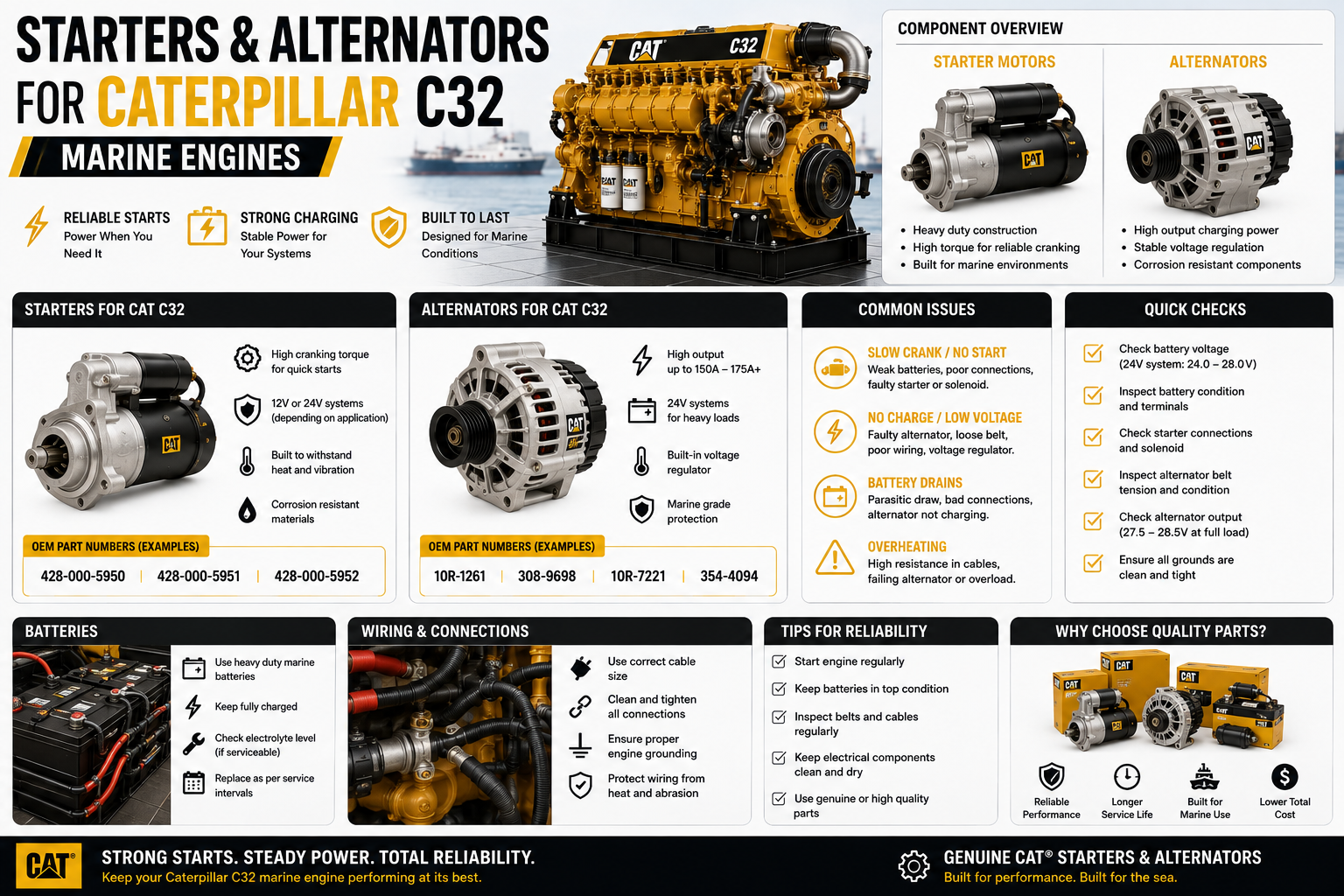

Starters & Alternators for Caterpillar C32 Marine Engines
The Caterpillar C32 marine engine depends on a strong electrical system every time the vessel starts, operates, shuts down and prepares for the next trip.
Two components are especially important:
the starter motor and the alternator.
The starter has one demanding job: turn a large V12 diesel engine fast enough for reliable starting.
The alternator has another: maintain electrical supply and recharge the batteries while the engine is running.
When either component begins to deteriorate, the first warning signs may appear small.
The C32 cranks more slowly than usual.
The starter clicks but does not turn the engine.
Starting becomes intermittent.
Battery voltage gradually falls.
An alternator begins running unusually hot.
Or the engine starts perfectly after shore-power charging, only for the same weak-battery problem to return a few days later.
These symptoms should not automatically lead to:
“Replace the starter.”
or:
“Replace the alternator.”
On a Caterpillar C32, the complete system matters:
batteries → cables → grounds → controls → starter → alternator → charging system.
1. Caterpillar C32 Marine Engine
The Caterpillar C32 is a large V12 four-stroke marine diesel engine with approximately 32.1 liters of displacement.
It is used in applications including:
- Motor yachts
- Sportfishing vessels
- Commercial vessels
- Passenger craft
- Patrol boats
- Workboats
- Fishing vessels
- Marine generator installations
Different C32 generations, ratings and applications can use different electrical components.
That means:
“C32 starter”
is not always enough information to identify the correct part.
Always include the engine serial number and existing starter or alternator number where possible.
2. What Does the Starter Motor Do?
The starter converts electrical energy from the starting batteries into mechanical rotation.
The starting sequence is approximately:
Battery bank
↓
Battery cables
↓
Isolation / starting circuit
↓
Starter solenoid
↓
Starter motor
↓
Flywheel / ring gear
↓
Engine rotates
↓
Combustion begins
Once the C32 starts and reaches self-sustaining speed, the starter disengages.
The starting process only lasts a short time, but electrical demand is very high.
3. Why Starting a C32 Requires a Healthy Electrical System
A C32 is not a small auxiliary diesel.
The starter has to rotate:
- 12 cylinders
- Crankshaft
- Pistons
- Connecting rods
- Valve-train components
- Other rotating assemblies
while overcoming cylinder compression and internal friction.
Anything that reduces available starter power can therefore affect starting performance.
This includes:
- Weak batteries
- Corroded terminals
- Undersized or damaged cables
- Poor grounds
- Starter wear
4. Situation: The C32 Cranks Slowly
Slow cranking is one of the most common starting complaints.
Do not immediately assume the starter motor has failed.
Possible causes include:
- Low battery charge
- Worn batteries
- Corroded battery terminals
- Loose electrical connections
- High-resistance battery cables
- Poor engine ground
- Starter deterioration
- Excessive mechanical resistance
The correct approach is to inspect the complete starting circuit.
5. Battery Voltage Can Look Normal Until the Starter Is Used
A battery can show apparently acceptable voltage while sitting at rest.
Then the starter is engaged.
Voltage falls dramatically.
This is why battery condition should be evaluated under load, not only with the engine stopped.
A large voltage drop during cranking can point toward:
- Weak batteries
- Poor connections
- Cable resistance
- Battery-bank problems
6. Cranking Voltage Is Important
If available voltage falls too far while cranking, the starter may not rotate the C32 fast enough.
Possible symptoms include:
- Slow engine rotation
- Difficult starting
- Starter solenoid chatter
- Repeated failed starts
Do not judge battery condition from resting voltage alone.
Observe what happens when current demand becomes high.
7. Voltage-Drop Testing Can Find Hidden Resistance
A starter circuit can look perfect visually and still contain excessive electrical resistance.
Problem areas can include:
- Battery posts
- Cable ends
- Master switches
- Starter terminals
- Ground connections
- Internal cable corrosion
Voltage-drop testing while cranking can help identify where energy is being lost.
8. Do Not Forget the Ground Connection
The electrical circuit needs a good return path.
A poor ground can produce symptoms almost identical to a weak starter.
Inspect:
- Battery negative cables
- Engine ground straps
- Ground terminals
- Connection surfaces
- Corrosion
- Loose bolts
A starter can only receive full power if both sides of the circuit are healthy.
9. Situation: Starter Clicks but C32 Does Not Crank
You press start.
You hear:
click.
But the engine does not move.
Possible causes include:
- Weak batteries
- Low cranking voltage
- Loose terminals
- Starter solenoid problem
- Starter motor fault
- Cable resistance
- Ground problem
- Starting relay/control issue
Do not repeatedly operate the starter without diagnosing the cause.
10. Situation: Nothing Happens When Start Is Commanded
No click.
No starter movement.
No cranking.
Now investigate the control circuit as well as the high-current side.
Possible areas include:
- Start command
- Battery isolation
- Control voltage
- Start relay
- Safety interlocks
- Neutral-position interlock
- Wiring
- Starter solenoid
A no-response condition does not automatically prove the starter motor itself is defective.
11. Starting Interlocks Matter
Marine propulsion systems may use safety interlocks to prevent starting under inappropriate conditions.
Depending on vessel configuration, the starting system may interact with:
- Marine gear neutral position
- Engine controls
- Emergency-stop system
- Control station
- Engine monitoring system
If the starter does nothing, verify that a safety condition is not preventing the start command.
12. Starter Works Sometimes and Sometimes Does Not
Intermittent electrical faults can be among the hardest to diagnose.
Possible causes include:
- Loose cable
- Corroded terminal
- Internal starter wear
- Solenoid deterioration
- Relay problem
- Intermittent wiring fault
Record:
- Engine temperature
- Battery voltage
- Whether the fault occurs hot or cold
- Whether moving a switch or cable changes the behavior
Intermittent faults usually leave clues.
13. Starter Works Cold but Fails Hot
A C32 may start normally in the morning and struggle after operating for several hours.
Heat can influence:
- Starter motor
- Solenoid
- Cable resistance
- Connections
- Battery performance
If the fault consistently appears when the engine room is hot, that pattern is useful.
14. Do Not Crank the C32 Continuously
Starter motors are designed for relatively short duty cycles.
Repeated extended cranking generates significant heat.
If the engine does not start, continuing to crank may damage a healthy starter while doing nothing to solve the original problem.
Stop and investigate:
- Fuel supply
- Engine controls
- Battery condition
- Starter circuit
15. Long Cranking May Be Caused by Another Engine System
The starter may be working correctly.
The engine may simply not be starting.
Possible causes include:
- Fuel starvation
- Air in the fuel system
- Fuel pressure problems
- Sensor faults
- Engine-control problems
- Low cranking speed
Do not replace the starter because the engine requires too many seconds to start until you know why.
16. Starter Pinion and Ring Gear
The starter has to engage mechanically with the flywheel/ring gear.
Possible problems can involve:
- Starter pinion teeth
- Engagement mechanism
- Ring-gear teeth
- Starter mounting
- Alignment
Listen carefully during starting.
17. Grinding Noise During Starting
A metallic grinding sound should not be ignored.
Possible causes include:
- Damaged starter pinion
- Damaged ring gear
- Poor engagement
- Loose starter
- Incorrect starter installation
Continued use can increase damage.
18. Starter Spins but Engine Does Not Turn
If you hear the starter rotating freely while the crankshaft is not turning normally, inspect the mechanical engagement system.
This is different from:
slow cranking
or:
no electrical power.
Understanding the sound can help separate the fault types.
19. What Does the Alternator Do?
Once the Caterpillar C32 is running, the alternator helps supply electrical power and recharge the batteries.
The basic process is:
Engine rotation
↓
Alternator
↓
Electrical output
↓
Battery bank + engine electrical system
A healthy charging system helps ensure the batteries are ready for the next engine start.
20. Alternator Problems Often Look Like Battery Problems
Imagine the following sequence:
Monday:
C32 starts normally.
Tuesday:
Cranking becomes slower.
Wednesday:
Battery is nearly flat.
The batteries are charged.
Then the same situation returns several days later.
Now you need to ask:
“Why are the batteries not staying charged?”
The battery may not be the original cause.
The charging system may be.
21. Signs of a C32 Alternator Problem
Possible signs include:
- Low charging voltage
- Battery warning
- Batteries repeatedly discharged
- Unstable system voltage
- Alternator overheating
- Abnormal alternator noise
- Charging output changing unexpectedly with RPM
The alternator should be tested together with the batteries and wiring.
22. Check Alternator Output With the Engine Running
The charging system should be evaluated under actual operating conditions.
Monitor:
- Battery voltage
- Charging voltage
- Engine RPM
- Electrical load
- Battery condition
A charging system may appear acceptable with little load and fail once vessel electrical demand increases.
23. Low Charging Voltage
Possible causes can include:
- Alternator deterioration
- Wiring resistance
- Loose connection
- Ground problem
- Drive problem
- Charging-control problem
- Battery issue
Do not diagnose an alternator from one display reading alone.
Verify the system physically and electrically.
24. Alternator Produces No Charge
If the C32 is running but system voltage does not show the expected charging behavior, inspect:
- Alternator wiring
- Main output terminal
- Ground path
- Drive arrangement
- Control or excitation circuit
- Protection devices
- Alternator itself
Start with the simplest external checks.
25. Alternator Drive Condition
The alternator has to be mechanically driven by the engine.
Depending on installation, inspect:
- Drive belt
- Pulley
- Tension
- Alignment
- Drive coupling
- Bearings
A healthy alternator cannot generate correctly if it is not being driven properly.
26. Belt Problems
Where a belt drive is used, look for:
- Cracking
- Fraying
- Glazing
- Incorrect tension
- Oil contamination
- Pulley misalignment
A slipping belt can reduce charging output without the alternator itself being defective.
27. Alternator Bearing Noise
During engine-room rounds, listen for:
- Rumble
- Whine
- Grinding
- Squealing
An alternator bearing beginning to fail may provide warning long before complete alternator failure occurs.
28. Alternator Running Too Hot
Possible causes include:
- Excessive electrical load
- Internal electrical fault
- Poor ventilation
- Bearing deterioration
- Loose/high-resistance connection
Compare with the normal temperature behavior of the installation.
A noticeable change deserves investigation.
29. Oil Leaks Can Damage Alternators
A C32 alternator should not be covered in engine oil.
If oil repeatedly reaches the alternator, inspect nearby:
- Oil lines
- Filters
- Gaskets
- Turbocharger oil connections
- Engine seals
Do not replace alternators repeatedly without fixing the leak that is contaminating them.
30. Coolant or Seawater Near Electrical Components
Moisture and saltwater can damage:
- Alternators
- Starter motors
- Cable terminals
- Connectors
- Wiring
After a seawater leak or engine-room flooding incident, inspect the starting and charging systems carefully.
Salt contamination can continue causing corrosion long after the water is gone.
31. Exhaust Heat Can Damage Starter and Alternator Wiring
The C32 is turbocharged and produces considerable exhaust heat.
A small exhaust leak can direct hot gas toward:
- Wiring harnesses
- Battery cables
- Alternator wiring
- Starter wiring
- Electrical connectors
Over time this can harden or melt insulation.
An electrical fault may therefore begin as an exhaust-system fault.
32. Inspect Wiring Near the Turbocharger and Exhaust
Look for:
- Hardened insulation
- Discoloration
- Chafing
- Melted protective covering
- Loose clamps
- Wiring routed too close to hot components
Correct routing and support help protect the electrical system.
33. Wiring Harness Condition
Marine engine-room vibration can damage harnesses gradually.
Inspect for:
- Rubbing
- Broken clips
- Unsupported wiring
- Corrosion
- Damaged connectors
- Heat exposure
A perfect alternator or starter cannot compensate for damaged wiring.
34. Hot Battery Cable or Terminal
A cable connection that develops excessive resistance generates heat when current flows.
If one starter cable becomes abnormally hot during cranking, investigate.
Possible causes include:
- Loose connection
- Corrosion
- Damaged cable
- Poor terminal contact
Heat is a useful clue.
35. Batteries Are Part of the Starter System
Do not treat the starter independently from the batteries.
Inspect:
- Battery state of charge
- Battery age/condition
- Terminal cleanliness
- Cable condition
- Battery-bank configuration
- Charging history
A perfectly good C32 starter will still crank badly with weak batteries.
36. Repeatedly Flat Batteries Need an Explanation
Possible causes include:
- Alternator not charging properly
- Aging batteries
- Electrical loads while engine is stopped
- Poor connections
- Charging-system faults
Repeated charging without diagnosis only resets the symptom.
Find out why the energy is disappearing.
37. Twin C32 Engines Provide a Useful Reference
Many yachts and commercial vessels use twin C32 engines.
That gives you a built-in diagnostic reference.
For example:
Port C32: fast, strong cranking
Starboard C32: noticeably slower cranking
Compare:
- Battery-bank condition
- Cranking voltage
- Ground connections
- Cable temperature
- Starter behavior
Differences are useful.
38. Compare Alternator Performance Between Engines
Twin installations can also help identify charging differences.
Compare:
- Running voltage
- Battery condition
- Electrical load
- Alternator temperature
But only compare engines if the battery banks and electrical loads are comparable.
A larger hotel load on one side can explain some differences.
39. Starting Problems Immediately After Maintenance
If the C32 started perfectly before service and suddenly does not crank afterward, inspect the work that was just performed.
Check:
- Battery isolators
- Starter cables
- Grounds
- Harness connectors
- Relays
- Engine-control connections
What changed just before the fault appeared?
This question often saves time.
40. Starting Problems After Engine Removal or Overhaul
After major work, verify:
- Ground straps reinstalled
- Starter cables tight
- Correct wiring connections
- Battery bank connected correctly
- Starter mounting
- Engine-control connections
A missing ground can create very confusing symptoms.
41. Problems After Starter Replacement
If a new starter is installed but slow cranking remains, check:
- Battery condition
- Cable resistance
- Ground path
- Correct starter specification
- Starter mounting
- Control voltage
A new starter cannot fix a bad battery cable.
42. Problems After Alternator Replacement
After fitting a new or remanufactured alternator, verify:
- Correct component
- System voltage
- Output rating
- Wiring
- Ground
- Drive
- Charging behavior
A replacement should be tested in the complete system.
43. C32 and C32B Electrical Parts Are Not Automatically the Same
The Caterpillar C32 and C32B belong to the same broad engine-family evolution, but electrical components should not automatically be considered interchangeable.
Differences may involve:
- Starter
- Alternator
- Sensors
- Harnesses
- Connectors
- Control systems
Always identify the exact engine.
44. Caterpillar C32 Starter Identification
For correct starter sourcing, provide:
Engine: Caterpillar C32
Engine Serial Number: __________
Serial Prefix: __________
Arrangement Number: __________
Starter Manufacturer: __________
Starter Part Number: __________
System Voltage: __________
Quantity: __________
Photographs: Attached
This is much better than:
“Need C32 starter.”
45. Caterpillar C32 Alternator Identification
For the alternator, provide:
Engine: Caterpillar C32
Engine Serial Number: __________
Serial Prefix: __________
Arrangement Number: __________
Alternator Manufacturer: __________
Alternator Part Number: __________
System Voltage: __________
Rated Output: __________
Quantity: __________
Photographs: Attached
The existing alternator identification plate can be extremely useful.
46. Why the C32 Serial Number Matters
The C32 has been produced in different:
- Generations
- Ratings
- Applications
- Electronic configurations
The engine serial number helps identify the actual build configuration.
When sourcing electrical parts, use:
engine model + serial number + existing component number.
That greatly reduces identification errors.
47. Do Not Order by Appearance
Two starters can look almost identical.
They can still differ in:
- Voltage
- Rotation
- Pinion specification
- Mounting
- Output
- Solenoid
- Electrical terminals
The same applies to alternators.
Looks the same does not mean is the same.
48. C32 Starter & Alternator Inspection Checklist
During routine engine-room inspection:
☐ Check battery voltage
☐ Inspect battery terminals
☐ Inspect starter cables
☐ Check engine grounds
☐ Listen to cranking speed
☐ Listen for grinding during starting
☐ Check charging voltage
☐ Inspect alternator drive
☐ Listen for alternator bearing noise
☐ Check for hot cables
☐ Inspect starter and alternator for oil contamination
☐ Look for coolant or seawater exposure
☐ Inspect wiring near turbocharger/exhaust
☐ Review charging or electrical alarms
The purpose is to identify deterioration before the C32 refuses to start.
49. Common Caterpillar C32 Starting & Charging Parts
Depending on engine configuration and vessel installation, requirements may include:
- Starter motors
- Starter solenoids
- Starter relays
- Alternators
- Voltage regulators
- Battery cables
- Ground cables
- Electrical terminals
- Wiring harnesses
- Connectors
- Sensors
- Charging-system components
- Mounting hardware
- Electrical protection components
Correct identification is essential.
50. Other Components That Can Cause Starting Problems
A no-start or slow-start complaint may involve:
- Batteries
- Battery switches
- Fuel system
- Engine speed sensors
- Control modules
- Harnesses
- Relays
- Neutral/start interlocks
- Emergency-stop system
Do not allow the starter motor to become the automatic suspect every time the engine refuses to start.
51. Other Components That Can Cause Charging Problems
Charging complaints can involve:
- Batteries
- Alternator
- Drive belt
- Wiring
- Grounds
- Isolation switches
- Voltage regulator
- Vessel electrical load
The complete charging circuit should be evaluated.
52. Frequently Asked Questions
Why Does My Caterpillar C32 Crank Slowly?
Possible causes include weak batteries, poor cable connections, excessive resistance, bad grounds or starter deterioration.
Why Does the C32 Starter Click but Not Turn?
The issue can involve insufficient battery power, loose connections, the solenoid, starter motor or starting-control circuit.
Why Does My Starter Work Sometimes?
Intermittent problems can result from loose connections, relay faults, solenoid wear, internal starter wear or wiring problems.
Can Weak Batteries Damage the Starter?
Repeated long cranking caused by inadequate battery power can increase starter heating and stress.
Why Do My C32 Batteries Keep Going Flat?
Possible causes include alternator charging problems, aging batteries, parasitic electrical loads or poor connections.
Can a Bad Ground Cause Slow Cranking?
Yes. High resistance on the ground side can reduce current available to the starter.
Can an Alternator Fail While the Engine Keeps Running?
Yes. Depending on the vessel electrical arrangement, the engine may continue operating while battery charging is inadequate.
Should I Replace the Starter if the C32 Cranks Slowly?
Not before checking batteries, cables, connections, grounds and cranking voltage.
Can an Exhaust Leak Damage Starter or Alternator Wiring?
Yes. Heat from an exhaust leak can damage nearby cables, insulation and connectors.
Are C32 and C32B Starters the Same?
Do not assume so. Verify the exact engine serial number and existing component number.
What Information Is Needed for a C32 Starter or Alternator?
Provide the engine serial number, serial prefix, arrangement number, system voltage, existing starter or alternator number and photographs.
Caterpillar C32 Marine Engine Electrical Spare Parts
Alfa Marine Spare Parts can assist with inquiries for Caterpillar C32 starting, charging and engine electrical components, including:
- Starter motors
- Alternators
- Starter solenoids
- Relays
- Wiring harnesses
- Engine cables
- Ground straps
- Electrical connectors
- Sensors
- Charging components
- Electrical-control components
Related C32 engine parts may also include:
- Fuel injectors
- Turbochargers
- Fuel pumps
- Oil pumps
- Freshwater pumps
- Seawater pumps
- Heat exchangers
- Aftercoolers
- Cylinder heads
- Pistons
- Cylinder liners
- Bearings
- Gaskets
- Seals
- Filters
- Overhaul parts
Browse Our Complete Catalog
Marine engine brands:
https://alfamarinespareparts.com/our-brand
Marine spare parts:
https://alfamarinespareparts.com/spareparts
Contact Alfa Marine Spare Parts
For Caterpillar C32 starter motors, alternators and marine engine electrical spare parts:
Email: request@alfamarinespareparts.com
For faster identification, provide:
Caterpillar C32 serial number + serial prefix + arrangement number + starter/alternator part number + voltage + quantity + photographs + delivery location.
Final Word
When a Caterpillar C32 marine engine develops a starting or charging problem, resist the temptation to immediately replace the starter or alternator.
Follow the complete electrical path.
For starting:
battery → cable → connection → ground → control circuit → starter → engine.
For charging:
engine drive → alternator → wiring → battery bank → vessel electrical system.
If the C32 cranks slowly, the starter may indeed be worn.
But it may also be:
a weak battery.
a corroded terminal.
a damaged cable.
a poor ground.
If batteries keep going flat, the batteries themselves may be tired.
But the alternator may also not be charging them correctly.
And if electrical wiring repeatedly fails near the turbocharger or exhaust system, heat exposure or an exhaust leak may be the real cause.
The best warning often comes before complete failure:
cranking becomes slightly slower.
charging voltage changes.
a cable starts running hot.
the starter occasionally clicks instead of turning.
the alternator develops a new bearing noise.
These are the clues worth investigating early.
Because on a C32, discovering a high-resistance cable or weak battery during a routine inspection is much easier than discovering it when the vessel needs the engine—and the starter does nothing.