Caterpillar C32 Marine Engines: Types, Systems & How They Work
The Caterpillar C32 marine engine is more than one engine configuration. Built around a 32.1-liter V12 four-stroke diesel platform, the C32 family has been developed for commercial propulsion, high-performance propulsion, auxiliary power and marine generator applications. The later C32B generation expands the family further with commercial and high-performance configurations, including Twin Turbo and Sequential Turbo versions.
For marine engineers and mechanics, these differences matter. Two engines carrying the C32 name can have different duty ratings, turbocharging arrangements, cooling systems, emissions equipment and supporting components.
For parts and engine information, visit CAT C32 Marine Engine Spare Parts | Caterpillar C32 Parts.
What Types of Caterpillar C32 Marine Engines Are There?
The C32 family can be divided into several major marine applications. Caterpillar currently lists C32-family engines across commercial propulsion, high-performance propulsion, marine generator and auxiliary categories. The later C32B family includes commercial propulsion, auxiliary, Twin Turbo and Sequential Turbo versions.
| C32 configurationTypical role | |
| Caterpillar C32 Commercial Propulsion | Commercial vessel propulsion |
| Caterpillar C32 High Performance | High-performance propulsion |
| Caterpillar C32 Auxiliary | Auxiliary marine machinery |
| Caterpillar C32 Marine Generator Set | Onboard electrical generation |
| Caterpillar C32B Commercial Propulsion | Later-generation commercial propulsion |
| Caterpillar C32B Auxiliary | Later-generation auxiliary applications |
| Caterpillar C32B Twin Turbo | High-performance propulsion |
| Caterpillar C32B Sequential Turbo | Higher-output high-performance propulsion |
These configurations belong to the same broad C32 lineage, but C32 should never be treated as a universal parts specification.
Caterpillar C32 Commercial Propulsion
The Caterpillar C32 Marine Engine is widely used for marine propulsion where high torque, compact V12 packaging and sustained power are required.
Depending on rating and specification, C32 commercial engines are found in workboats, fishing vessels, passenger craft, patrol vessels, pilot boats, offshore vessels and other demanding installations. Alfa Marine's Caterpillar reference material also identifies applications ranging from superyachts and sportfishing boats to fast ferries and commercial workboats.
An important distinction within the commercial C32 range is the cooling arrangement. Selected ratings use Separate Circuit Aftercooling (SCAC) while other duty configurations use Seawater Aftercooling (SWAC).
This matters during troubleshooting because a mechanic cannot assume that every C32 has exactly the same seawater and charge-air cooling arrangement.
Caterpillar C32 High-Performance Propulsion
C32 high-performance engines are intended for applications where high output and power density are particularly important.
These installations can be found in larger yachts, sportfishing vessels and other high-performance craft. The underlying four-stroke combustion process remains familiar, but higher output increases the demands placed on the fuel, turbocharging, charge-air cooling, lubrication and seawater systems.
At high load, even a relatively small deterioration in airflow or heat-transfer capacity can become significant.
For example, a C32 may appear perfectly normal during dockside operation but develop high coolant temperature or reduced power during a full-load sea trial. The reason is often that the engine's thermal and airflow requirements are dramatically higher under propulsion load.
Caterpillar C32 Auxiliary Engine
The C32 platform is also used as a marine auxiliary engine. Caterpillar's current marine range continues to list C32-family auxiliary configurations.
Instead of driving the vessel's propeller through a marine gearbox, an auxiliary engine can provide mechanical power for other onboard machinery.
This changes the diagnostic picture.
A propulsion engine experiences load primarily according to propeller demand and vessel resistance. An auxiliary engine may instead be loaded by pumps, hydraulic equipment or another driven system.
When diagnosing an auxiliary C32 that cannot maintain RPM, the mechanic therefore needs to consider both the engine and the machinery being driven.
Caterpillar C32 Marine Generator Set
The C32 is also used for marine electrical generation. Caterpillar's current marine range lists the C32 among its marine generator-set families.
The fundamental diesel engine still converts fuel energy into crankshaft rotation, but instead of driving a propeller, the crankshaft drives a generator that converts mechanical power into electrical energy.
Generator installations can differ from propulsion engines in their governing, cooling arrangement, electrical equipment, mounting and operating profile.
That is another reason a request simply stating “Caterpillar C32 part” is often insufficient.
Caterpillar C32B Commercial Propulsion
The C32B is a later development of the C32 platform.
Current Caterpillar information places commercial C32B output across approximately 1200–1700 bhp, depending on rating. Caterpillar also describes changes to the core architecture, including strengthened or redesigned block, crankshaft, bearings, connecting rods and cylinder heads to support higher power density and durability.
This distinction is extremely important for parts identification.
A component used on an earlier C32 should not automatically be assumed to fit a C32B because the displacement and cylinder configuration are similar.
Use the complete model, serial number, arrangement number and existing part number whenever possible.
Caterpillar C32B Twin Turbo
The C32B Twin Turbo belongs to Caterpillar's high-performance marine propulsion family.
A published high-performance C32B rating reaches 2000 bhp / 1491 bkW at 2300 rpm. Caterpillar describes this configuration as a development of the established C32 platform for high-performance marine applications.
At this level of output, turbocharger efficiency, charge-air temperature, exhaust conditions and cooling-system performance become especially important.
A developing restriction may not produce a noticeable symptom at low engine load but can become obvious when the engine is required to deliver high output continuously.
Caterpillar C32B Sequential Turbo
The C32B Sequential Turbo is another high-performance configuration, but its turbocharging arrangement deserves particular attention.
Caterpillar specifies systems including ADEM VI electronic control, MEUI-C fuel equipment, seawater aftercooling, a titanium plate heat exchanger, front and rear seawater pumps, gear-driven jacket-water and seawater pumps, and water-cooled exhaust manifolds and turbochargers.
This makes sequential-turbo diagnosis different from simply looking at a conventional turbocharger in isolation.
When investigating low boost, smoke, high exhaust temperature or reduced acceleration, the mechanic should consider how the complete air, fuel and turbocharging system behaves as engine load changes.
Caterpillar C32B Auxiliary
The later C32B platform also extends into auxiliary applications in Caterpillar's current marine engine range.
Again, application matters.
A C32B auxiliary engine and a high-performance C32B Sequential Turbo propulsion engine may share the broader engine family name, but their operating requirements are very different.
For sourcing purposes, C32B alone is not enough identification.
How Does a Caterpillar C32 Marine Engine Work?
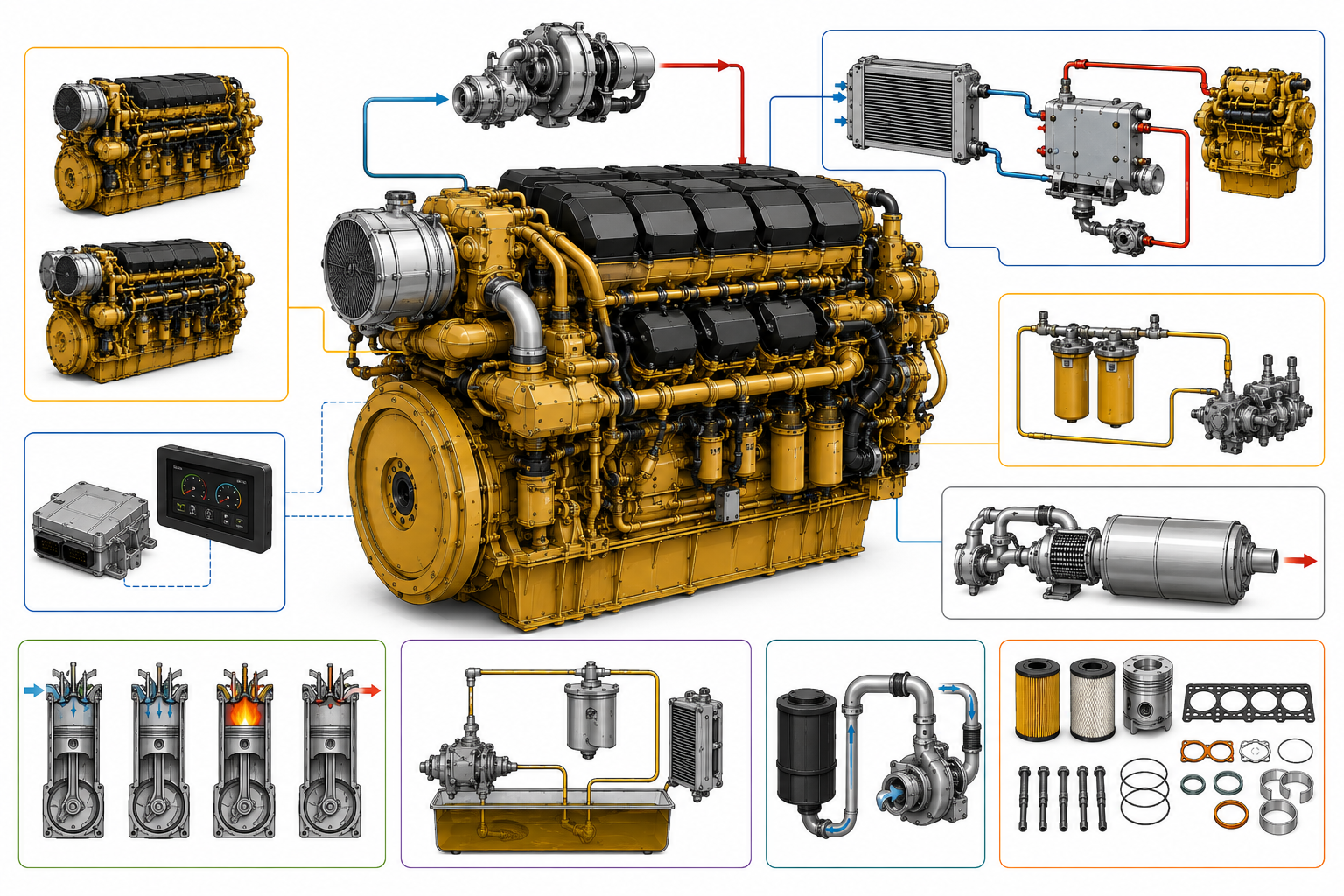
Regardless of application, the mechanical foundation is the familiar four-stroke diesel cycle:
Intake → Compression → Power → Exhaust
During intake, air enters the cylinder. The piston then moves upward and compresses that air, significantly increasing its pressure and temperature.
Fuel is introduced near the end of compression. Combustion rapidly raises cylinder pressure and forces the piston downward.
The connecting rod transfers this force to the crankshaft, converting reciprocating piston movement into rotational torque.
During the exhaust stroke, combustion gases leave the cylinder. On a turbocharged C32, those gases still contain substantial energy and are used to drive the turbocharger turbine.
This creates an important mechanical relationship:
Combustion creates exhaust energy → exhaust drives turbocharging → turbocharging provides more combustion air → additional air allows more fuel to be burned efficiently.
Understanding this relationship is central to diagnosing C32 performance problems.
How Fuel Delivery and Turbocharging Work Together
Increasing fuel alone does not produce reliable diesel power.
The engine also needs enough oxygen to burn that fuel efficiently.
As load increases, the turbocharging system must provide greater airflow. Exhaust gas drives the turbine, which turns the compressor and increases the mass of intake air supplied to the engine.
The airflow path can be simplified as:
Air intake → Turbocharger compressor → Aftercooling → Intake manifold → Cylinders → Combustion → Exhaust → Turbocharger turbine
Aftercooling is important because compressed air becomes hotter. Reducing its temperature increases density, allowing more oxygen mass to enter each cylinder.
This is why boost pressure, exhaust temperature, smoke and engine load should be evaluated together.
Low boost does not automatically mean the turbocharger needs replacing. Intake restrictions, charge-air leaks, cooling problems, exhaust restrictions and excessive vessel loading can create similar symptoms.
Why Caterpillar C32 Engines Overheat Under Load
One of the most useful C32 diagnostic clues is when an overheating problem occurs.
Consider a vessel where the engine maintains normal temperature while idling alongside the quay but begins running hot during a sustained sea trial.
That does not necessarily mean the cooling system has suddenly stopped working.
More often, it suggests that available cooling capacity has become insufficient for the heat being generated.
As engine load rises:
Fuel consumption ↑ → Combustion heat ↑ → Exhaust heat ↑ → Cooling demand ↑
A partially restricted seawater circuit may therefore provide enough cooling at idle while becoming inadequate at high output.
Possible areas include seawater pumps, intake restrictions, strainers, hoses, heat-transfer surfaces, aftercooling circuits and jacket-water circulation.
The exact C32 configuration must also be considered because SCAC and SWAC engines should not be diagnosed as though their cooling circuits were identical.
How Lubrication Protects the C32
Lubricating oil protects heavily loaded moving components throughout the engine, including crankshaft journals, main bearings, connecting-rod bearings, valve-train components and turbocharger bearings.
Oil also helps carry heat away from components and transports contamination toward the filtration system.
For this reason, oil pressure is useful diagnostic information—but only when operating conditions are considered.
Suppose a C32 historically maintains a particular oil pressure at normal oil temperature and a known RPM. Months later, the hot oil pressure is consistently lower under comparable conditions.
That does not automatically prove that the oil pump is failing.
Oil temperature, viscosity, contamination, filtration condition and increasing internal bearing clearances can all influence pressure.
The better question is:
What changed compared with the engine's previous known-good operating condition?
Why C32 Problems Often Appear Only at High Load
A C32 can sound excellent at idle while still having a developing problem.
At low engine load, fuel demand, airflow, boost, cylinder pressure and cooling requirements remain relatively modest.
Under heavy load:
Fuel demand ↑ → Air demand ↑ → Boost requirement ↑ → Cylinder pressure ↑ → Exhaust temperature ↑ → Cooling demand ↑ → Mechanical load ↑
A partially restricted fuel supply may therefore support low-speed operation but become inadequate at high fuel demand.
A contaminated aftercooling system may perform acceptably during maneuvering yet become restrictive when airflow increases.
A deteriorating seawater pump may maintain normal engine temperature at the dock but fail to deliver enough flow during sustained high-output operation.
This is why sea-trial data is so valuable.
Instead of simply recording “C32 loses power,” determine when the loss begins and what happens simultaneously to RPM, boost pressure, exhaust temperature, coolant temperature, oil pressure and smoke.
What Should Marine Engineers Monitor?
Good C32 diagnosis is built around operating trends rather than isolated measurements.
Useful information can include:
Engine RPM, engine load, boost pressure, coolant temperature, oil pressure, oil temperature, exhaust temperature, fuel consumption and vessel speed.
Imagine that a vessel historically reaches cruising speed at a known RPM with stable boost and exhaust temperatures.
Later, the same vessel requires more throttle to reach the same speed. Boost has fallen slightly, exhaust temperature has increased and maximum RPM is lower.
Those readings become much more useful when considered together.
Compare present RPM, boost, coolant temperature, oil pressure and exhaust temperatures against original commissioning or known-good sea-trial data where available. This can help establish whether the root cause is an engine restriction, cooling problem, fuel or air-system issue, or an external physical load such as hull fouling or propeller condition.
Caterpillar C32 Marine Engine Parts
The exact parts requirement depends heavily on C32 generation, application and arrangement.
Common component groups include fuel injectors, high-pressure fuel components, turbochargers, seawater pumps, jacket-water pumps, oil pumps, heat exchangers, aftercooler components, oil coolers, cylinder heads, pistons, piston rings, cylinder liners, connecting rods, main bearings, connecting-rod bearings, gasket sets, seals, O-rings, sensors, ECM-related components, starter motors, alternators and overhaul parts. Alfa Marine's Caterpillar catalogue lists these as common C32 sourcing categories.
Explore the dedicated CAT C32 Marine Engine Spare Parts | Caterpillar C32 Parts page.
For other Caterpillar engines, visit the Caterpillar Marine Engine Parts section.
You can also browse the Marine Spare Parts Catalogue.
Why Exact C32 Identification Matters When Ordering Parts
The complete C32 family now makes the identification problem clearer:
C32 Commercial Propulsion
C32 High Performance
C32 Auxiliary
C32 Marine Generator Set
C32B Commercial Propulsion
C32B Auxiliary
C32B Twin Turbo
C32B Sequential Turbo
Within these groups there are also different duty ratings, emissions configurations, cooling arrangements and engine arrangements.
Therefore, avoid ordering a component using only:
“CAT C32 seawater pump”
or:
“Caterpillar C32 turbocharger.”
For accurate identification, provide:
Complete engine model + engine serial number + arrangement number + existing part number + quantity + application
Clear photographs of the engine identification plate and existing component can also help.
Frequently Asked Questions
Is the Caterpillar C32 a V12?
Yes. The Caterpillar C32 is built around a 32.1-liter V12 four-stroke diesel architecture.
What are the main Caterpillar C32 marine engine types?
The principal marine applications include C32 commercial propulsion, C32 high-performance propulsion, C32 auxiliary and C32 marine generator configurations, together with later C32B commercial, C32B auxiliary, C32B Twin Turbo and C32B Sequential Turbo engines.
Is the C32B the same as the C32?
No. C32B is a later development of the platform. Caterpillar describes significant changes to the core architecture, and parts should not be assumed interchangeable simply because both engines are C32-family V12s.
What is a C32B Sequential Turbo?
It is a high-performance C32B configuration using sequential turbocharging. Caterpillar's current specification includes ADEM VI control, MEUI-C fuel equipment, seawater aftercooling, titanium plate heat exchange and front and rear seawater pumps.
Why does a C32 overheat only under load?
A cooling system operating at reduced capacity may still control temperature at idle. Higher engine load produces much more heat, exposing restrictions, deteriorating pumps or reduced heat-transfer efficiency.
Does low boost mean the turbocharger has failed?
Not necessarily. Air restrictions, boost leaks, aftercooling problems, exhaust conditions and excessive engine loading can also reduce boost.
What information should I send when requesting C32 parts?
Send the complete engine model, serial number, arrangement number, existing part number, quantity and delivery destination. Photos are useful when identification is uncertain.
Request Caterpillar C32 Marine Engine Parts
Whether you are working on a C32 commercial propulsion engine, C32 high-performance engine, C32 auxiliary, C32 generator set, C32B commercial engine, C32B auxiliary, C32B Twin Turbo or C32B Sequential Turbo, correct engine identification should come before parts selection.
Alfa Marine Spare Parts supplies and sources Caterpillar marine components for shipowners, ship managers, shipyards, marine engineers, engine rebuilders, repair companies and vessel operators.
For a quotation, send:
Engine model + serial number + arrangement number + part number + quantity + photographs + delivery destination
Email: request@alfamarinespareparts.com
Submit your requirement through Request a Quote | Alfa Marine Spare Parts.
The better approach in Caterpillar C32 diagnostics is to establish which C32 configuration is installed, what changed, when the symptom appears and which operating parameters change with it. Across a family ranging from commercial propulsion and generator engines to the C32B Twin Turbo and Sequential Turbo, that reasoning helps separate a relatively straightforward restriction from a more complicated cooling, fuel, turbocharging or mechanical problem.
You can explore the complete CAT C32 Marine Engine Spare Parts | Caterpillar C32 Parts catalogue or visit Alfa Marine Spare Parts.