
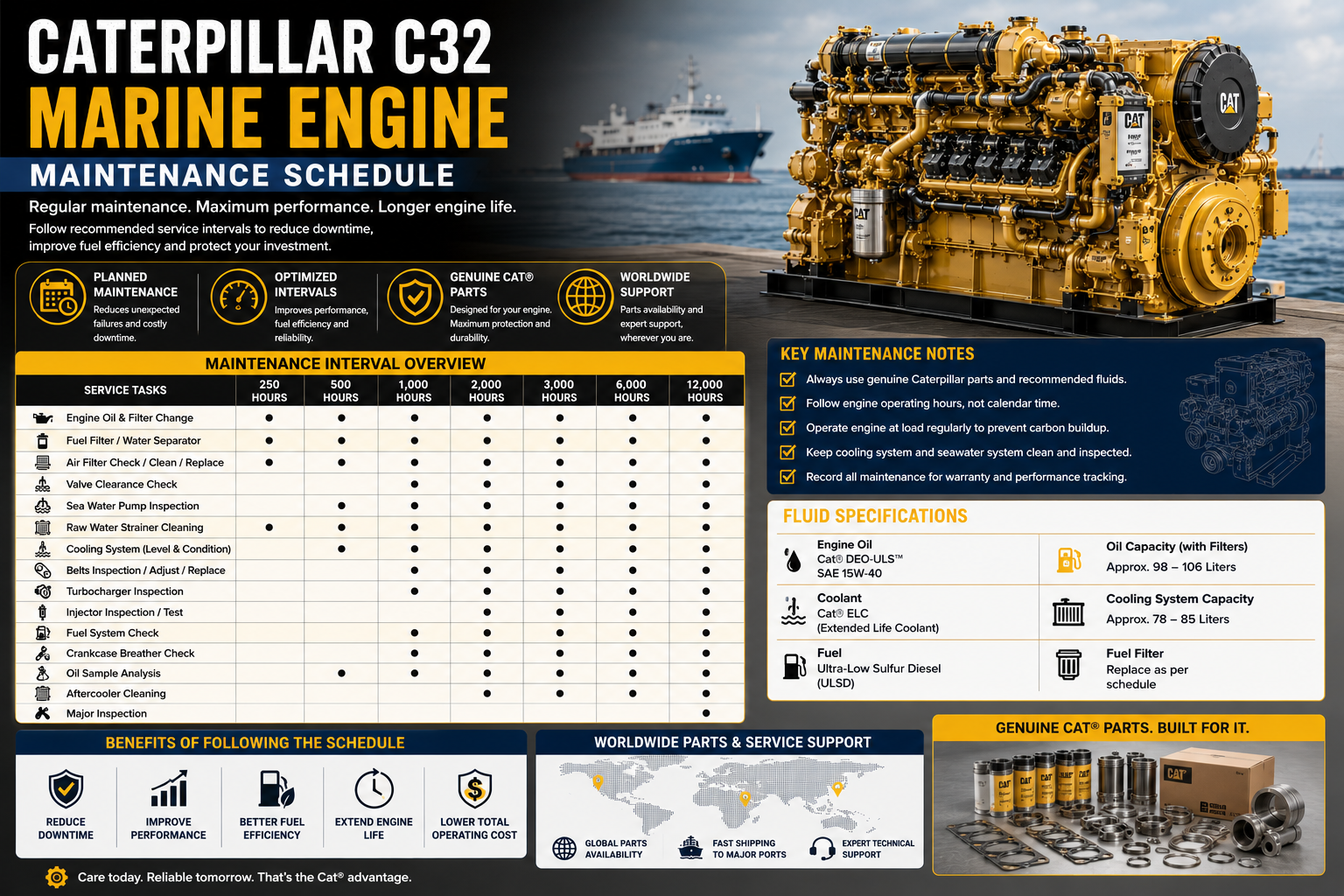
Caterpillar C32 Marine Engine Maintenance Schedule: Turning Service Hours Into Real Fleet Planning
The Caterpillar C32 marine engine is widely used in commercial and high-performance marine propulsion, but its maintenance plan should never be reduced to one generic list of intervals.
Why?
Because the C32 exists in different ratings and cooling configurations, and Caterpillar itself publishes different oil-change limits depending on rating. Current Caterpillar information, for example, lists extended oil-change intervals of 1,000 hours for A ratings, 750 hours for B ratings, and 500 hours for C ratings on applicable current C32 commercial propulsion engines.
That immediately tells us something important:
The engine rating matters.
So does the serial number, application, operating environment, oil condition, fuel quality, cooling-system condition, and the specific Operation & Maintenance Manual for the engine.
For fleet managers, though, there is another useful question:
What do those operating hours mean in months?
That is where maintenance becomes much easier to organize.
Where Does the Caterpillar C32 Fit?
Manufacturer: Caterpillar
Engine Family: C-Series
Engine Model: Caterpillar C32 Marine Engine
Configuration: V12 diesel engine
Applications: Commercial propulsion, recreational propulsion, auxiliary and marine generator applications depending on configuration
Current Caterpillar C32 commercial propulsion engines are available across different ratings and cooling arrangements. Caterpillar identifies separate-circuit aftercooling on some ratings and seawater aftercooling on others, which is another reason maintenance must follow the correct engine configuration.
How to Read the Maintenance Blocks
For easy fleet planning, we'll use two operating profiles:
Low Usage: 3,000 operating hours per year
High Usage: 5,000 operating hours per year
The calculation is:
Maintenance interval ÷ annual operating hours × 12 = approximate months
For example:
⏱️ 500-Hour Service
Low Usage — 3,000 hours/year: about 2 months
High Usage — 5,000 hours/year: about 1.2 months
These month figures are only planning tools. The actual maintenance requirement comes from the applicable Caterpillar OMM.
Caterpillar's C32 documentation also notes that severe operating conditions may require more frequent maintenance.
Caterpillar C32 Marine Engine Maintenance Planning
Daily / Before Operation
🟦 DAILY ENGINE CHECKS
Interval: Every day / before operation
Low Usage: Daily
High Usage: Daily
Check:
- Engine oil level
- Coolant level
- Fuel-water separator
- Leaks
- Engine alarms
- Unusual noise
- Exhaust smoke
- Cooling-water discharge
- Belt condition where visible
- Overall engine-room condition
Engineer Focus: A daily inspection is not simply a checklist. Look for changes from yesterday.
Caterpillar's C32 operation and maintenance documentation is organized around preventive maintenance intended to reduce unscheduled downtime and failures.
Initial 10-Hour Inspection
🟦 INITIAL 10 SERVICE HOURS
Interval: First 10 hours
Typical task: Belt inspection / adjustment / replacement as required.
Engineer Focus: This is especially relevant after commissioning, belt replacement, or major work where belt seating may change.
A C32 maintenance schedule available through Caterpillar-related documentation lists belt inspection/adjustment/replacement at the initial 10-hour point.
Every 50 Service Hours or Weekly
🟦 50 HOURS / WEEKLY
Low Usage: roughly every 0.2 months
High Usage: roughly every 0.12 months
Key Tasks:
- Clean and inspect seawater strainer
- Inspect and replace zinc rods/anodes as required
Engineer Focus: On a marine engine, seawater-side maintenance can be just as important as internal engine maintenance.
The C32 maintenance schedule lists the sea-water strainer and zinc rods at every 50 service hours or weekly.
Why This Matters
A blocked seawater strainer may not immediately trigger an alarm.
At low load, the engine may appear completely normal.
Under heavy load, however, reduced seawater flow can show up as:
- Rising coolant temperature
- Higher aftercooler temperature
- Reduced heat-exchanger performance
- Higher engine-room temperature
This is why weekly seawater-side inspection deserves respect.
Every 250 Service Hours
🟦 250-HOUR SERVICE
Low Usage — 3,000 hours/year: approximately 1 month
High Usage — 5,000 hours/year: approximately 0.6 month
Verified C32 task: Obtain a Level 1 coolant sample
Depending on engine configuration/manual: additional routine inspections may also fall at this service level.
Engineer Focus: Coolant analysis can detect developing cooling-system problems before corrosion or overheating becomes obvious.
The C32 maintenance schedule specifically lists a coolant sample, Level 1, every 250 hours.
Oil and Oil Filter Change: Rating Matters
This is where the C32 becomes especially interesting.
Caterpillar's current commercial propulsion page states that applicable C32 engines can have extended oil-change intervals based on rating:
🟩 C32 A RATING
Oil Change Interval: up to 1,000 hours
Low Usage: approximately 4 months
High Usage: approximately 2.4 months
🟩 C32 B RATING
Oil Change Interval: up to 750 hours
Low Usage: approximately 3 months
High Usage: approximately 1.8 months
🟩 C32 C RATING
Oil Change Interval: up to 500 hours
Low Usage: approximately 2 months
High Usage: approximately 1.2 months
Caterpillar publicly lists these extended oil-change intervals for current C32 commercial propulsion ratings.
Important: Don't apply these numbers blindly to every C32. Older C32 variants, different serial prefixes, D/E ratings, recreational installations, auxiliary engines, or generator-set applications may have different requirements.
Why Oil Analysis Matters
Suppose two C32 engines both reach 500 operating hours.
Engine A has:
- Stable viscosity
- No water
- Low fuel dilution
- Normal wear metals
- Good oil pressure
Engine B shows:
- Fuel dilution
- Increasing iron
- Higher copper
- Rising oil temperature
They have the same number of hours.
They do not have the same condition.
That is why operating hours and condition monitoring should work together.
Every 500 Service Hours
One Caterpillar maintenance guideline for the C32 specifically identifies engine valve lash inspection at 500 service hours.
🟦 500-HOUR SERVICE
Low Usage: about 2 months
High Usage: about 1.2 months
Important Task: Check engine valve lash
Engineer Focus: Record the values before adjustment. Repeated movement on the same cylinder can provide useful diagnostic information.
Don't Just Adjust the Valves
If one cylinder repeatedly requires a larger correction than the others, ask why.
Investigate:
- Valve condition
- Valve seat
- Rocker components
- Injector performance
- Combustion temperature
- Cylinder-head condition
The measurement is useful.
The trend is even more useful.
Fuel Filters
The exact fuel-filter interval should be confirmed from the engine-specific Caterpillar documentation. Caterpillar's C32 SCAC project guide explicitly directs users to SISweb for the fuel-filter maintenance intervals rather than presenting one universal figure.
So instead of inventing a generic C32 number:
🟨 FUEL FILTER MAINTENANCE
Interval: Verify in the specific Caterpillar OMM / SIS for your engine
Fleet Planning: Once confirmed, convert the interval to months
Engineer Focus: Monitor restriction, contamination, water and injector performance.
Important: Do not copy a fuel-filter interval from another C32 rating or serial prefix without verification.
This is the safer way to build the maintenance plan.
Air Filter Maintenance
🟨 AIR FILTER
Interval: Caterpillar schedule + service indicator / condition
Low Usage: Convert verified interval
High Usage: Convert verified interval
Engineer Focus: Don't wait for severe restriction. Airflow directly affects turbocharger and combustion performance.
Restricted intake air can contribute to:
- Black smoke
- Reduced power
- High exhaust temperature
- Increased fuel consumption
- Turbocharger stress
Seawater Pump and Cooling System
The C32 is offered in different marine cooling arrangements. Current Caterpillar commercial propulsion information notes SCAC for some ratings and SWAC for others.
That means seawater-side maintenance is configuration-sensitive.
🟦 SEAWATER SYSTEM INSPECTION
Weekly / 50 Hours: Strainer and zinc rods on the referenced maintenance schedule
Pump Service: Follow C32-specific OMM/SIS interval
Inspect:
- Pump seals
- Shaft condition
- Bearings
- Impeller where applicable
- Housing corrosion
- Suction restriction
- Seawater discharge
- Heat-exchanger condition
Engineer Focus: A cooling problem may appear only at high engine load.
Aftercooler Maintenance
Caterpillar's C32 maintenance documentation includes specific procedures for aftercooler-core cleaning/testing, including debris removal, chemical cleaning where appropriate, flushing, and inspection.
🟦 AFTERCOOLER MAINTENANCE
Interval: Follow engine-specific C32 maintenance schedule
Service Focus:
- Remove debris
- Clean core
- Flush thoroughly
- Inspect for leakage
- Check condensate drain operation
Engineer Focus: A dirty aftercooler can look like a turbocharger or fuel problem because it changes charge-air temperature and airflow.
1,000-Hour Planning Example
Even where a specific component interval must still be confirmed, a 1,000-hour planning box is useful for fleet forecasting.
⏱️ IF A VERIFIED TASK IS DUE AT 1,000 HOURS
Low Usage: approximately 4 months
High Usage: approximately 2.4 months
Use this only after confirming that the particular C32 maintenance item is actually scheduled at 1,000 hours.
2,000-Hour Planning Example
⏱️ IF A VERIFIED TASK IS DUE AT 2,000 HOURS
Low Usage: approximately 8 months
High Usage: approximately 4.8 months
Fleet Focus: This is where long-lead parts planning becomes increasingly important.
3,000-Hour Maintenance
Caterpillar's current C32 Marine Parts Store dashboard explicitly identifies a 3,000 service-hour maintenance interval for C32 Marine equipment.
🟥 3,000-HOUR MAINTENANCE
Low Usage — 3,000 hours/year: approximately 12 months
High Usage — 5,000 hours/year: approximately 7.2 months
Importance: Major scheduled maintenance point shown in Caterpillar's current C32 Marine maintenance structure.
Engineer Focus: Verify the exact task list against the engine serial number and OMM before ordering the service package.
This is a perfect example of why fleet planning is useful.
A 3,000-hour maintenance point:
- arrives approximately once per year at 3,000 annual hours;
- arrives in only about 7.2 months at 5,000 annual hours.
5,000-Hour Valve Lash Check
The C32 maintenance material also indicates valve lash is revisited at the 5,000-hour interval.
🟥 5,000-HOUR SERVICE
Low Usage: approximately 20 months
High Usage: approximately 12 months
Verified task: Engine valve lash inspection appears again at this service level.
Engineer Focus: Compare these values with the earlier 500-hour records.
This is exactly why recording actual valve measurements matters.
At 5,000 hours, you can compare what changed.
What About Complete Engine Overhaul?
A Caterpillar C32 major overhaul should not automatically be assigned one universal number without identifying the exact engine, duty rating, serial prefix and operating history.
Caterpillar's C32 overhaul guidance treats overhaul timing as condition- and application-dependent and provides dedicated procedures for major overhaul.
So the proper planning block is:
🟥 C32 MAJOR OVERHAUL
Interval: Confirm from specific C32 OMM / engine history / Caterpillar recommendations
Do Not Assume: 10,000, 12,000 or another generic hour value applies to every C32
Plan for:
- Cylinder heads
- Pistons
- Cylinder liners
- Main bearings
- Connecting-rod bearings
- Crankshaft inspection
- Fuel injectors
- Turbochargers
- Water pumps
- Oil pump
- Aftercooler
- Heat exchangers
- Gasket and seal sets
Engineer Focus: Measure first. Replace according to condition and approved overhaul scope.
Caterpillar C32 Maintenance Summary
⚙️ QUICK C32 FLEET PLANNING BLOCK
| IntervalLow Usage 3,000 h/yrHigh Usage 5,000 h/yrConfirmed / Key Maintenance | |||
| Daily | Daily | Daily | Fluid levels, leaks, visual/operational checks |
| Initial 10 h | — | — | Belt inspection/adjustment |
| 50 h / Weekly | 0.2 mo | 0.12 mo | Seawater strainer; zinc rods |
| 250 h | 1 mo | 0.6 mo | Level 1 coolant sample |
| 500 h | 2 mo | 1.2 mo | Valve lash; C-rating oil interval on applicable current engines |
| 750 h | 3 mo | 1.8 mo | B-rating oil interval on applicable current engines |
| 1,000 h | 4 mo | 2.4 mo | A-rating oil interval on applicable current engines |
| 3,000 h | 12 mo | 7.2 mo | Caterpillar C32 Marine maintenance interval exists; verify exact task list |
| 5,000 h | 20 mo | 12 mo | Valve lash appears again in referenced C32 guidance |
| Major Overhaul | Engine-specific | Engine-specific | Use OMM, engine condition, rating and serial number |
Engineer's Toolbox
CATERPILLAR C32 FLEET RECORD
Vessel: __________________
Engine: Caterpillar C32 Marine
Serial Prefix / Serial Number: __________________
Rating: A / B / C / D / E / Other
Cooling Configuration: __________________
Current Hours: __________________
Annual Operating Hours: __________________
Next Oil Service: __________________
Next 250-Hour Service: __________________
Next 500-Hour Service: __________________
Next 3,000-Hour Maintenance: __________________
Last Oil Analysis: __________________
Last Coolant Analysis: __________________
Parts Ordered: __________________
Outstanding Repairs: __________________
Marine Engineer Tip
Always record the C32 rating together with the engine model.
“Caterpillar C32” alone may not tell you enough to select the correct maintenance interval.
The oil-change example proves why:
A rating ≠ B rating ≠ C rating.
What Should You Monitor Between Scheduled Services?
A maintenance calendar is useful, but the engine can ask for attention earlier.
Watch:
- Oil pressure
- Oil temperature
- Fuel consumption
- Oil consumption
- Coolant temperature
- Coolant level
- Exhaust smoke
- Turbocharger boost
- Exhaust temperature
- Seawater flow
- Filter restriction
- Vibration
- Oil-analysis results
- Coolant-analysis results
- Repeated fault codes
The schedule tells you when to inspect.
Trend monitoring tells you when something is changing.
Caterpillar C32 Parts Fleet Managers Should Plan For
Depending on maintenance scope:
- Oil filters
- Fuel filters
- Air filters
- Fuel injectors
- Turbochargers
- Seawater pumps
- Freshwater pumps
- Heat exchangers
- Aftercooler components
- Thermostats
- Cylinder heads
- Valves
- Valve-train components
- Pistons
- Piston rings
- Cylinder liners
- Main bearings
- Connecting-rod bearings
- Crankshaft components
- Sensors
- Gasket kits
- O-rings and seals
Caterpillar's Parts Store provides C32 Marine maintenance and repair solutions tied to specific equipment identification, which is exactly how high-value component sourcing should be handled.
Common C32 Maintenance Planning Mistakes
Avoid:
- Applying one oil interval to every C32.
- Ignoring the rating.
- Ignoring serial-number-specific maintenance information.
- Waiting for overheating before checking seawater flow.
- Ignoring weekly seawater-strainer maintenance.
- Adjusting valve lash without recording measurements.
- Treating fuel filters as universal interval items without checking SIS/OMM.
- Copying generator-set intervals to a propulsion engine.
- Copying propulsion intervals to an auxiliary engine.
- Ordering expensive overhaul components before inspection.
- Ignoring severe operating conditions.
Frequently Asked Questions
Is every Caterpillar C32 maintenance schedule the same?
No. C32 maintenance varies by application, serial number, rating and configuration. Caterpillar provides engine-specific service information and manuals.
How often should oil be changed on a C32 marine propulsion engine?
On applicable current commercial propulsion models, Caterpillar lists 1,000 hours for A ratings, 750 hours for B ratings and 500 hours for C ratings. Always confirm applicability to your specific engine.
When should the seawater strainer be inspected?
The referenced C32 marine maintenance schedule specifies every 50 service hours or weekly.
When is valve lash checked?
Referenced C32 maintenance material identifies valve-lash inspection at 500 hours and again at 5,000 hours.
Is there a 3,000-hour C32 service?
Yes. Caterpillar's current C32 Marine Parts Store shows a 3,000 service-hour maintenance event. The exact tasks should be verified against your equipment configuration.
Can the maintenance intervals be converted into months?
Yes, for planning purposes. Divide the verified maintenance interval by expected annual operating hours and multiply by 12.
Related Caterpillar C32 Marine Engine Parts
Alfa Marine Spare Parts can assist with sourcing:
- Caterpillar C32 oil filters
- Caterpillar C32 fuel filters
- Caterpillar C32 air filters
- Caterpillar C32 injectors
- Caterpillar C32 turbochargers
- Caterpillar C32 seawater pumps
- Caterpillar C32 freshwater pumps
- Caterpillar C32 heat exchangers
- Caterpillar C32 cylinder heads
- Caterpillar C32 valves
- Caterpillar C32 piston kits
- Caterpillar C32 cylinder liners
- Caterpillar C32 bearings
- Caterpillar C32 gasket sets
- Caterpillar C32 overhaul components
Worldwide Caterpillar Marine Spare Parts Supply
Alfa Marine Spare Parts supports shipyards, ship repairers, marine engineers, chief engineers, technical superintendents, fleet operators, commercial fishing companies, offshore operators, government fleets, maritime contractors, boat builders and marine equipment distributors.
For Caterpillar components, always provide:
Engine model + serial number + arrangement number + existing part number + quantity + photographs where available.
That information greatly reduces part-identification errors.
Browse Our Complete Catalog
Website:
https://alfamarinespareparts.com
Marine Spare Parts Catalog:
https://alfamarinespareparts.com/spareparts
Why Choose Alfa Marine Spare Parts?
A useful C32 maintenance supplier should not just ask:
“What part number?”
Sometimes the customer only knows:
“C32 seawater pump.”
or:
“C32 500-hour service.”
The important next questions are:
Which C32?
Which rating?
Which serial number?
Which cooling configuration?
Which maintenance interval?
Alfa Marine Spare Parts helps customers source genuine, OEM, aftermarket, remanufactured and reconditioned Caterpillar marine components, depending on availability and application.
The objective is simple:
get the right parts ready before the engine reaches the service hour.
Contact Alfa Marine Spare Parts
Email: request@alfamarinespareparts.com
Website:
https://alfamarinespareparts.com
Catalog:
https://alfamarinespareparts.com/spareparts
Contact Alfa Marine Spare Parts for Caterpillar C32 filters, injectors, seawater pumps, heat exchangers, turbochargers, cylinder heads, bearings, pistons, liners, gasket kits and overhaul components with worldwide supply.
One Final Thought
A Caterpillar C32 Marine Engine Maintenance Schedule becomes much easier to manage when every important hour interval is converted into a clear planning block.
50 hours means weekly seawater-side attention.
250 hours can mean monthly planning on a heavily used vessel.
500 hours can arrive every five or six weeks in high-utilization service.
3,000 hours can arrive in only about seven months.
And the oil-change interval itself can change depending on the C32 rating.
So the best fleet-maintenance question isn't simply:
“How many hours does the engine have?”
It is:
“Which C32 do we have, what is due next, and do we already have the correct parts ready?”