
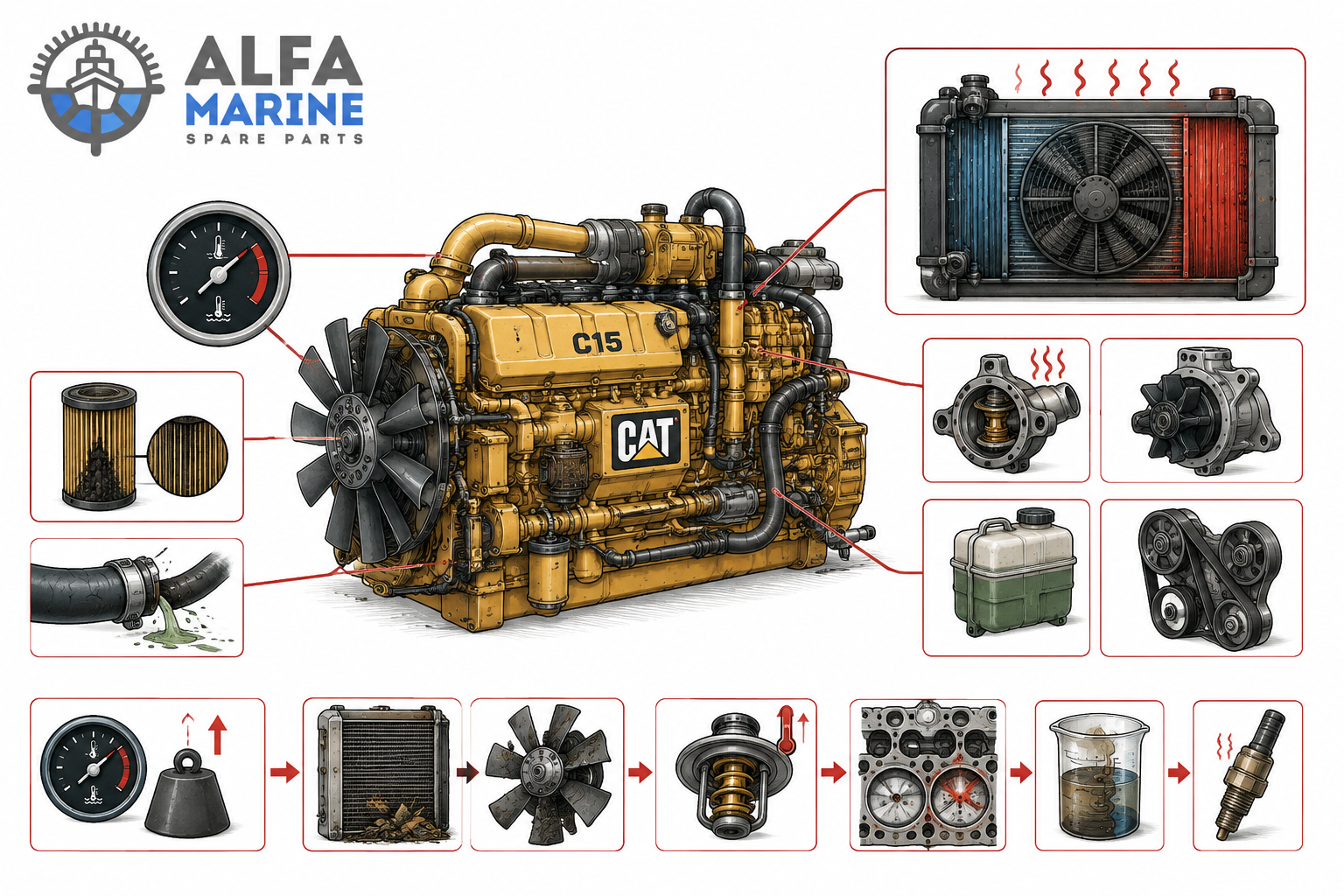
Why Is My Caterpillar C15 Marine Overheating Under Load?
A Caterpillar C15 marine engine that maintains normal temperature at idle but begins overheating under load is giving you an important diagnostic clue.
As engine load increases, combustion heat increases. The cooling system must remove that additional heat while maintaining adequate seawater flow, engine-coolant circulation and heat transfer.
A partially restricted cooling system may cope at idle but become unable to reject sufficient heat once the engine is operating under sustained load.
For engine-specific information and available components, see our Caterpillar C15 Marine Engine Parts page.
Common areas to investigate include:
- Auxiliary/seawater pump
- Seawater intake
- Sea strainer
- Heat exchanger
- Water temperature regulator
- Jacket-water circulation
- Coolant level and condition
- Oil cooler and aftercooler where applicable
- Restricted hoses or pipework
- Air trapped in the cooling system
- Excessive propulsion load
The important question is:
Why can the C15 control temperature at low load but not when producing sustained power?
Start With the C15 Seawater Circuit
On a heat-exchanger-cooled C15 marine installation, the seawater circuit is one of the first areas to investigate.
Depending on the installation, seawater can pass through:
Seacock → intake → sea strainer → auxiliary/seawater pump → coolers → heat exchanger → discharge
Check for:
- Blocked seawater intake
- Dirty sea strainer
- Marine growth
- Sand or mud
- Shell fragments
- Restricted hoses
- Collapsed suction hose
- Air entering the suction side
- Worn seawater pump
- Pump leakage
- Restricted heat exchanger
- Restricted oil cooler
- Restricted aftercooler where applicable
Visible water at the discharge does not prove that seawater flow is sufficient for full-load operation.
Can a Caterpillar C15 Auxiliary Pump Cause Overheating?
Yes.
On applicable C15 marine configurations, reduced auxiliary/seawater-pump performance can contribute to overheating under load.
A deteriorating pump may provide sufficient flow at low engine output but become inadequate as cooling demand increases.
Possible problems include:
- Internal wear
- Shaft wear
- Bearing wear
- Seal leakage
- Corrosion
- Restricted inlet
- Air entering the suction side
- Reduced pumping efficiency
A symptom such as:
Normal at idle → temperature rises progressively under load
makes seawater flow an important area to investigate.
Caterpillar C15 Auxiliary Seawater Pump References
Several pump references can appear across Caterpillar marine configurations.
Relevant numbers discussed when identifying C15/C18-family auxiliary seawater pumps include:
340-7732 / 3407732
276-5906 / 2765906
Other related references on our auxiliary seawater-pump product page include:
397-2684 / 3972684
375-4701 / 3754701
524-3160 / 5243160
You can view the product and associated references here:
397-2684 Caterpillar Auxiliary Sea Water Pump
Important: These numbers should not be treated as automatically interchangeable or universally applicable to every C15.
Always verify:
Engine Serial Number + arrangement number + existing pump number
before ordering.
Caterpillar 340-7732 / 3407732 Auxiliary Pump
The 340-7732 / 3407732 auxiliary pump is associated with selected Caterpillar marine applications including C15 configurations.
If this number is fitted to your engine, inspect the pump for:
- Leakage
- Shaft movement
- Bearing condition
- Internal wear
- Corrosion
- Restricted inlet
- Reduced seawater delivery
Our product page includes 340-7732 / 3407732 among its auxiliary seawater-pump references:
340-7732 Caterpillar Auxiliary Sea Water Pump
Caterpillar 276-5906 / 2765906 Auxiliary Pump
Another relevant auxiliary-pump reference is:
276-5906 / 2765906
If this number appears on the installed pump, record it together with the engine identification before requesting a replacement.
See the available related pump references here:
276-5906 Caterpillar Auxiliary Sea Water Pump
The engine model alone should not be used to determine pump compatibility.
Why Exact Pump Identification Matters
A request saying:
“I need a seawater pump for a Caterpillar C15.”
may not contain enough information.
Different C15 marine arrangements can have different cooling-system configurations.
For accurate identification provide:
- Caterpillar C15
- Engine Serial Number
- Serial-number prefix
- Arrangement number
- Existing pump part number
- Photograph of the pump
- Photograph of the engine data plate
You can browse the wider Caterpillar Marine Engine Parts range when additional engine components are required.
Could the C15 Heat Exchanger Be Fouled?
Yes.
A partially restricted heat exchanger is an important possibility when a C15 remains at normal temperature at idle but overheats during sustained load.
The heat exchanger transfers heat from the engine coolant into the seawater circuit.
Possible restrictions include:
- Salt deposits
- Scale
- Marine growth
- Sand
- Mud
- Shell fragments
- Corrosion products
- Pump or impeller debris
At idle, the exchanger may still transfer enough heat.
Under load:
Engine heat increases → heat-transfer capacity becomes insufficient → coolant temperature rises
This is why heat-exchanger restriction can create a load-dependent overheating problem.
What About Broken Impeller Pieces?
Where the particular seawater-pump design uses a flexible impeller, missing pieces should be located where practical.
Fragments can travel downstream and become trapped in:
- Heat exchanger passages
- Oil coolers
- Aftercoolers
- Hoses
- Pipe connections
- Restricted fittings
Replacing a damaged impeller does not necessarily remove debris that has already entered the cooling circuit.
Can the Water Temperature Regulator Cause Overheating?
Yes.
The water temperature regulator controls coolant flow as engine temperature changes.
Potential problems include:
- Failure to open correctly
- Partial opening
- Incorrect regulator
- Deposits
- Mechanical damage
- Incorrect installation
If coolant circulation becomes insufficient as engine heat production increases, the engine can overheat even when seawater flow appears acceptable.
Don't Ignore the Jacket-Water Circuit
The seawater system is only one side of the cooling process.
Heat must first move from the engine into the closed coolant circuit and then through the heat exchanger.
Check:
- Coolant level
- External leakage
- Coolant condition
- Correct coolant mixture
- Trapped air
- Restricted coolant passages
- Water temperature regulator
- Jacket-water circulation
- Cooling-system pressure
If overheating began after cooling-system maintenance, check carefully for trapped air or incorrect assembly.
Could Excessive Propulsion Load Cause C15 Overheating?
Yes.
If the cooling system appears to be operating correctly, determine whether the engine is being overloaded.
Possible causes include:
- Fouled hull
- Fouled propeller
- Damaged propeller
- Incorrect propeller pitch
- Excessive vessel loading
- Gearbox or driveline problems
A useful question is:
Can the engine achieve its expected rated RPM under normal full-load conditions?
If it cannot, investigate both engine performance and propulsion load.
Black Smoke Plus Overheating
If the C15 produces excessive black smoke while also overheating under load, broaden the investigation.
Check:
- Propulsion load
- Air intake
- Turbocharger performance
- Aftercooler condition
- Exhaust restriction
- Fuel-system condition
This combination can indicate that the problem is not limited to the cooling circuit.
Practical Caterpillar C15 Overheating Check
A logical diagnostic sequence is:
- Confirm actual engine temperature.
- Check coolant level and leakage.
- Inspect the seawater intake.
- Inspect the sea strainer.
- Evaluate seawater flow.
- Inspect the auxiliary/seawater pump.
- Record the pump part number.
- Check for suction-side air leakage.
- Inspect for downstream debris where applicable.
- Inspect the heat exchanger.
- Inspect applicable oil coolers and aftercoolers.
- Check water temperature regulator operation.
- Check jacket-water circulation.
- Check for trapped air.
- Confirm whether the engine achieves expected rated RPM under load.
- Investigate excessive propulsion load if necessary.
- Broaden the diagnosis to air, turbocharger, exhaust and fuel systems when the symptoms support it.
The objective is:
Find where cooling capacity is being lost before replacing parts.
Caterpillar C15 Cooling Parts & Internal Links
For C15 engine information and available component categories:
Caterpillar C15 Marine Engine Parts
For the auxiliary seawater-pump product and associated pump references:
397-2684 Caterpillar Auxiliary Sea Water Pump
For the complete Caterpillar marine range:
Caterpillar Marine Engine Parts
For the Caterpillar brand catalogue:
Caterpillar Parts
Request Caterpillar C15 Cooling Parts
If your Caterpillar C15 overheats under load, avoid replacing the seawater pump or heat exchanger based only on the symptom.
First determine where cooling capacity is being lost.
When requesting a pump or cooling component, provide:
Engine model + Engine Serial Number + arrangement number + existing component number + photographs
For auxiliary pump enquiries, useful references can include:
340-7732 / 3407732
276-5906 / 2765906
and, depending on the specific configuration and cross-reference:
397-2684 / 3972684
375-4701 / 3754701
524-3160 / 5243160
View Caterpillar Auxiliary Sea Water Pump
Request a Quote
Email: request@alfamarinespareparts.com
Alfa Marine Spare Parts
Frequently Asked Questions
Why does my Caterpillar C15 overheat only under load?
The cooling system may have enough capacity at idle but insufficient capacity as engine heat production increases. Check seawater flow, the auxiliary pump, heat exchanger, coolant circulation and water temperature regulator.
Can a C15 seawater pump cause overheating?
Yes. Reduced pump performance can contribute to overheating, particularly when cooling demand increases under load.
What Caterpillar auxiliary pump numbers should I check?
Relevant references include 340-7732 / 3407732 and 276-5906 / 2765906. Other related references listed on our pump product page include 397-2684 / 3972684, 375-4701 / 3754701 and 524-3160 / 5243160.
Exact compatibility must be verified from the engine configuration.
Are all of these C15 pump numbers interchangeable?
No. Do not assume that different Caterpillar pump numbers are interchangeable simply because they appear in the same engine family or product cross-reference.
Can a dirty heat exchanger cause overheating only under load?
Yes. A partially restricted exchanger can transfer enough heat at idle but become unable to reject sufficient heat as engine output increases.
Can a fouled propeller cause overheating?
It can contribute. Excessive propulsion load increases engine demand and can increase thermal stress.
What information should I provide when ordering a C15 seawater pump?
Provide the Engine Serial Number, arrangement number and existing pump part number, preferably together with photographs.