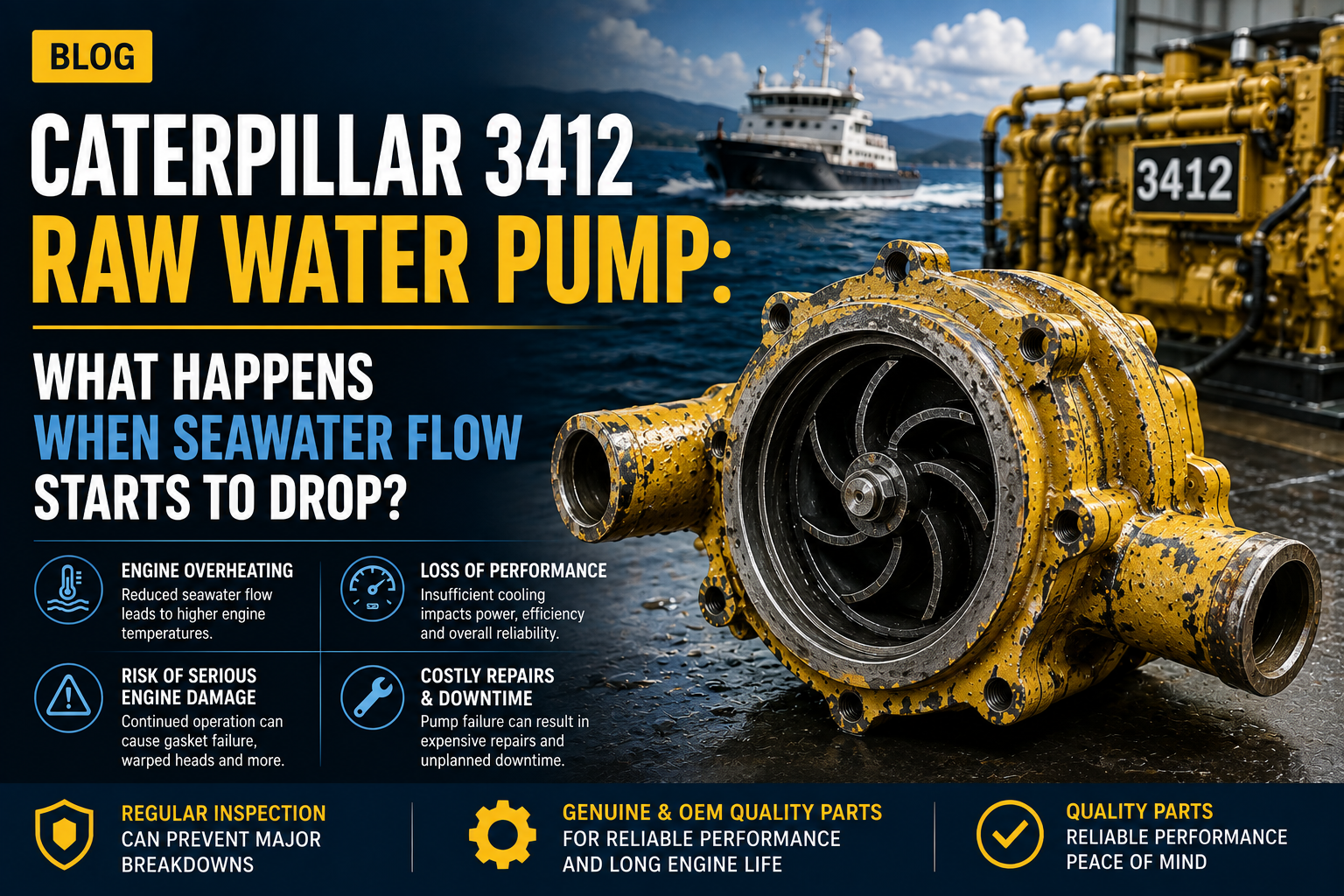
Caterpillar 3412 Raw Water Pump: What Happens When Seawater Flow Starts to Drop?
A Caterpillar 3412 Raw Water Pump is one of those components that can operate quietly for thousands of hours without attracting much attention from the engine-room crew.
Until the seawater flow starts dropping.
The engine may not immediately overheat. There may be no alarm. Oil pressure may remain normal, and the engine may still produce full power.
But something has changed inside the cooling system.
For an experienced marine engineer, this is where the interesting part begins: why is the raw-water flow decreasing, and what is the pump trying to tell you?
Caterpillar's 3412 marine documentation identifies the raw-water inlet, raw-water pump, raw-water heat exchanger and jacket-water pump as distinct parts of the cooling arrangement. This distinction matters because the seawater side and the engine's closed coolant circuit perform different jobs.
What Does the Caterpillar 3412 Raw Water Pump Actually Do?
The raw-water pump brings outside water—normally seawater—into the vessel's auxiliary cooling circuit.
The important point is that seawater does not necessarily circulate directly through the engine block.
Instead, depending on the installation, raw water passes through heat exchangers where it absorbs heat from the engine's closed freshwater/coolant circuit before being discharged.
Caterpillar describes its seawater pumps as circulating exterior water through the auxiliary cooling system.
A simplified flow can look like:
Sea Chest → Seacock → Raw-Water Strainer → Raw-Water Pump → Heat Exchanger / Auxiliary Coolers → Discharge
Meanwhile, the jacket-water pump circulates the engine coolant through the internal cooling circuit.
That separation is important when troubleshooting overheating.
Engineering Lesson: An Overheating 3412 Doesn't Automatically Mean a Bad Pump
Imagine the bridge reports that engine temperature is gradually increasing at high load.
The first reaction might be:
"Raw-water pump."
Maybe.
But replacing the pump immediately could be an expensive mistake.
Reduced seawater flow can originate from several places:
- Blocked sea strainer
- Partially closed seacock
- Damaged impeller
- Worn pump housing
- Air entering the suction side
- Collapsed or restricted hose
- Fouled heat exchanger
- Marine growth
- Damaged pump seal
- Worn shaft or bearings
- Debris inside the cooling circuit
This is why an experienced engineer looks at the entire raw-water circuit, not just the pump.
What Happens When Raw-Water Flow Slowly Decreases?
This is where the problem becomes interesting.
A completely failed pump is relatively easy to diagnose.
A pump that is still moving water—but not enough water—is more difficult.
At low engine load, everything may appear normal.
As engine load increases, however, the amount of heat that must be rejected also increases.
The reduced raw-water flow may no longer remove heat quickly enough.
You may begin noticing:
Higher coolant temperature under load
The temperature may remain normal at idle but rise when the vessel accelerates.
Increasing exhaust-related temperatures
Reduced cooling capacity can affect components throughout the thermal system.
Higher engine-room temperatures
Heat exchangers may no longer reject heat as effectively.
Temperature that drops when engine load decreases
This is particularly useful information.
If temperature rises at high load and falls again when the engine is unloaded, investigate cooling capacity and flow rather than assuming the temperature sensor is faulty.
Chief Engineer's Notebook
"Don't only ask whether the pump is turning. Ask whether it is moving enough water."
That difference can save hours of unnecessary troubleshooting.
Inside the Caterpillar 3412 Raw Water Pump
Caterpillar's current description of one 3412-compatible seawater pump refers to a bronze housing, stainless-steel structure, flexible impeller, bearing retention and oil/coolant seals.
Depending on the exact pump configuration, the components worth inspecting include:
Impeller
The impeller creates the water movement through the raw-water circuit.
Inspect for:
- Missing blades
- Cracking
- Hardened rubber
- Permanent blade deformation
- Hub damage
- Excessive wear
A pump can continue rotating even when its impeller is no longer producing sufficient flow.
Shaft
The shaft transfers mechanical rotation into the pump.
Inspect for:
- Corrosion
- Scoring
- Seal-area wear
- Excessive movement
- Shaft damage
Caterpillar specifically highlights corrosion-resistant shaft construction on its current 6I-1898 seawater pump.
Bearings
Bearings maintain proper shaft alignment.
Warning signs include:
- Noise
- Rough rotation
- Excessive shaft movement
- Heat
- Vibration
A bearing problem can eventually damage the seal and pump housing.
Pump Seals
The seal separates water from areas where it should not travel.
Look for:
- Water leakage
- Salt deposits
- Corrosion trails
- Leakage from drain/weep areas
- Evidence of previous overheating
A leaking seal should not simply be treated as an external leak. Determine why the seal failed.
Pump Housing
Seawater is extremely aggressive toward marine components.
Inspect the housing for:
- Corrosion
- Cavitation damage
- Erosion
- Internal scoring
- Distortion
- Damage around sealing surfaces
A new impeller installed inside a severely worn housing may still produce inadequate water flow.
Caterpillar 3412 Raw Water Pump Part Numbers
This section is especially important when sourcing replacement components.
There is not one universal raw-water pump for every Caterpillar 3412 engine.
Different engine arrangements and serial-number ranges can use different pump assemblies.
Some Caterpillar part numbers associated with 3412 applications include:
6I-1898 – Auxiliary/Sea Water Pump Group
Caterpillar currently identifies 6I-1898 as a seawater pump compatible with 3412 and 3412D marine engines.
Caterpillar also shows:
0R-7722 – Remanufactured Sea Water Pump
as an alternative associated with this pump.
197-4855 – Auxiliary Pump Group
Caterpillar lists 197-4855 as compatible with the 3412 marine engine, as well as 3408B applications.
The current Caterpillar listing also shows:
0R-7731 – Cat Reman Auxiliary Water Pump
as a remanufactured alternative.
7C-3613 – Auxiliary Sea Water Pump
Another important number is:
7C-3613
Caterpillar lists this auxiliary seawater pump across several marine applications, including:
- 3412
- 3412C
- 3412D
- 3408
- 3408B
- 3408C
depending on the engine configuration.
Never Order a Caterpillar 3412 Pump From the Engine Model Alone
This is one of the most important purchasing lessons in this article.
A customer may send an inquiry saying:
"Need raw-water pump for CAT 3412."
That information may not be enough.
The safer approach is to provide:
Engine model: Caterpillar 3412
Engine serial number: ______
Arrangement number: ______
Existing pump part number: ______
Photos of existing pump: Recommended
Caterpillar itself notes that changes in equipment configuration can affect whether a listed component fits a particular engine.
For marine spare-parts sourcing, verification is much cheaper than sending the wrong pump halfway around the world.
Don't Forget the Raw-Water Strainer
One of the easiest mistakes is blaming the pump when the pump cannot get enough water.
The raw-water strainer can collect:
- Seaweed
- Plastic
- Shell fragments
- Sand
- Marine growth
- Debris
A restricted suction supply can dramatically reduce pump performance.
So before condemning the Caterpillar 3412 Raw Water Pump, inspect the complete suction side.
What About Cavitation?
Cavitation is particularly destructive because a pump may still appear to be operating.
If pressure at the pump inlet becomes too low, vapor bubbles can form and collapse inside the pump.
Over time this can cause:
- Impeller erosion
- Housing damage
- Noise
- Vibration
- Reduced pump performance
Possible causes include a restricted strainer, blocked inlet, suction-side restriction or inadequate water supply.
An engineer hearing an unusual gravel-like or crackling sound from a raw-water pump should investigate rather than simply waiting for an overheating alarm.
Never Run a Flexible-Impeller Raw-Water Pump Dry
Flexible marine pump impellers depend on water for cooling and lubrication.
Caterpillar's older 3412 operation documentation specifically instructs operators to open the raw-water valve and prime the raw-water pump if the raw-water system has been drained.
That is an important practical lesson.
After:
- Winterization
- Heat exchanger maintenance
- Pump replacement
- Hose replacement
- Dry docking
- Cooling-system drainage
make sure the raw-water circuit is correctly restored before starting the engine.
A few moments of dry operation can damage some flexible impellers.
What Happens to Broken Impeller Pieces?
This is something experienced marine engineers already know—but it is worth emphasizing.
Replacing the impeller is only half the job.
If blades are missing, ask:
Where did they go?
Pieces may travel downstream and lodge inside:
- Heat exchangers
- Coolers
- Pipework
- Elbows
- Restricted passages
You can install a brand-new impeller and still have poor seawater flow because pieces of the old impeller remain downstream.
So when an impeller has missing vanes:
find the missing pieces.
Zinc Anodes Matter Too
Salt water is highly corrosive.
Historical Caterpillar 3412 operation documentation specifically discusses zinc rods in raw-water systems as protection against corrosive action in seawater service.
Inspect sacrificial anodes as part of cooling-system maintenance.
If the zinc is heavily consumed, replace it.
But also look at the bigger picture.
Unusual anode consumption may tell you something about:
- Water chemistry
- Electrical conditions
- Corrosion activity
- Maintenance intervals
A zinc plug is cheap.
A corroded heat exchanger or seawater pump housing is not.
Engine Room Reality: Don't Confuse the Two Water Pumps
The Caterpillar 3412 marine cooling system can include both a:
Raw-water pump
and
Jacket-water pump
They do different jobs.
Caterpillar systems documentation identifies them separately on the engine.
The raw-water pump moves external seawater through the auxiliary cooling side.
The jacket-water pump circulates engine coolant through the closed engine cooling circuit.
When troubleshooting overheating, determining which circuit has lost performance is much more useful than simply saying:
"The cooling system isn't working."
Real Marine Maintenance Scenario
Imagine a Caterpillar 3412-powered workboat operating normally at low speed.
At 1,200 rpm, coolant temperature looks fine.
The captain increases engine load.
After several minutes:
- Coolant temperature begins climbing.
- Exhaust temperatures increase.
- Engine remains smooth.
- Oil pressure remains normal.
- No obvious coolant leak exists.
The engineer reduces engine load.
Temperature begins returning toward normal.
This immediately suggests an important question:
Can the cooling system reject enough heat at full load?
Inspection finds:
- Raw-water strainer partially restricted.
- Impeller showing permanent deformation.
- Several heat-exchanger passages contaminated.
- Pump housing showing moderate wear.
No single component had completely failed.
Instead, several small losses in cooling efficiency combined to create a high-load overheating problem.
That is typical of real marine troubleshooting.
Engineer's Toolbox
When investigating a Caterpillar 3412 raw-water problem, check:
- Sea chest/inlet
- Seacock position
- Raw-water strainer
- Suction hoses
- Hose clamps
- Pump impeller
- Pump shaft
- Bearings
- Seals
- Pump housing
- Heat exchanger
- Zinc anodes
- Downstream restrictions
- Discharge flow
- Temperature difference across heat exchangers
The objective is not simply to find a broken part.
The objective is to understand why cooling capacity has changed.
Marine Engineer Tip
If an impeller has lost a blade, don't stop after replacing the impeller. Find the missing piece downstream.
That small fragment can restrict a heat exchanger and cause another overheating problem later.
Common Maintenance Mistakes
Some of the most common mistakes include:
- Replacing the pump before checking the strainer.
- Running the pump dry after maintenance.
- Installing an impeller without inspecting the housing.
- Ignoring worn bearings.
- Ignoring small seal leaks.
- Failing to retrieve broken impeller pieces.
- Neglecting zinc anodes.
- Assuming normal idle temperature means cooling capacity is healthy.
- Ordering a replacement pump using only "3412" as identification.
The last mistake is particularly expensive when international freight is involved.
Frequently Asked Questions
What does the Caterpillar 3412 Raw Water Pump do?
It moves seawater or other external water through the raw-water side of the marine cooling system, allowing heat exchangers and related cooling equipment to reject engine heat. Caterpillar describes its seawater pumps as circulating exterior water through the auxiliary cooling system.
Is the raw-water pump the same as the jacket-water pump?
No. Caterpillar 3412 marine systems documentation identifies the raw-water pump and jacket-water pump separately. They serve different cooling circuits.
What are the symptoms of a failing Caterpillar 3412 raw-water pump?
Possible signs include reduced seawater flow, overheating under load, leakage around the pump, abnormal pump noise, increased temperatures and deteriorated impeller condition.
Should I replace only the impeller?
Not automatically. Inspect the housing, shaft, seals, bearings and downstream cooling circuit as well. If pieces are missing from the old impeller, locate them.
What Caterpillar 3412 raw-water pump part numbers are available?
Depending on the engine arrangement, examples include 6I-1898, 197-4855 and 7C-3613. Caterpillar also lists remanufactured alternatives such as 0R-7722 and 0R-7731 for certain pump configurations.
How do I know which pump fits my Caterpillar 3412?
Use the engine serial number, arrangement number and existing pump part number whenever possible. Photos of the existing pump can provide additional confirmation.
Caterpillar 3412 Raw Water Pump Parts
When servicing the cooling system, Alfa Marine Spare Parts can assist with sourcing components such as:
- Complete raw-water pumps
- Remanufactured seawater pumps
- Impellers
- Pump shafts
- Bearings
- Mechanical seals
- O-rings
- Gaskets
- Zinc anodes
- Heat exchangers
- Seawater hoses
- Thermostats
- Freshwater pumps
- Water-cooled exhaust manifolds
Availability and compatibility should always be confirmed against the specific engine configuration.
Worldwide Caterpillar Marine Spare Parts Supply
Alfa Marine Spare Parts supports:
- Shipyards
- Ship repairers
- Marine engineers
- Chief engineers
- Technical superintendents
- Fleet operators
- Marine service companies
- Commercial fishing companies
- Offshore operators
- Government fleets
- Maritime contractors
- Boat builders
- Marine equipment distributors
We supply Caterpillar marine engine parts for commercial vessels, workboats, fishing vessels, offshore vessels, tugboats and yachts, with worldwide shipping to major marine locations including Spain, Italy, Monaco, the Netherlands, United Kingdom, Dubai/UAE, Nigeria, Miami, Texas, Toronto, Brazil and other major international ports.
Browse Our Complete Catalog
Explore our marine diesel engine components, cooling-system parts, pumps and overhaul components:
Alfa Marine Spare Parts
Caterpillar | Alfa Marine Spare Parts
Browse Our Complete Spare Parts Catalog
Marine Spare Parts Categories | Alfa Marine Spare Parts
Related Products
Consider inspecting or sourcing alongside a Caterpillar 3412 Raw Water Pump:
- Caterpillar 3412 heat exchangers
- Caterpillar 3412 water-cooled exhaust manifolds
- Caterpillar 3412 seawater pump impellers
- Caterpillar 3412 thermostats
- Caterpillar 3412 freshwater pumps
- Caterpillar 3412 oil coolers
- Caterpillar 3412 gasket kits
- Caterpillar 3412 cylinder heads
- Caterpillar 3412 turbochargers
- Caterpillar 3412 overhaul components
Related Engine Pages
- Caterpillar 3408 Marine Engine Spare Parts
- Caterpillar 3412 Marine Engine Spare Parts
- Caterpillar C18 Marine Engine Spare Parts
- Caterpillar C32 Marine Engine Spare Parts
- Caterpillar 3512 Marine Engine Spare Parts
- Caterpillar 3516 Marine Engine Spare Parts
Why Choose Alfa Marine Spare Parts?
Finding a pump is easy.
Finding the correct pump for a particular Caterpillar 3412 arrangement is where experience matters.
Alfa Marine Spare Parts helps customers source genuine, OEM, aftermarket, remanufactured and reconditioned Caterpillar marine engine components while paying close attention to part-number and engine-configuration identification.
When requesting a quotation, send us:
Engine model + serial number + arrangement number + existing part number + photos where available.
That information helps us identify the correct component faster and reduces the possibility of ordering errors.
Contact Alfa Marine Spare Parts
Email: request@alfamarinespareparts.com
www.alfamarinespareparts.com
Browse the Marine Spare Parts Catalog
Contact us for Caterpillar 3412 Raw Water Pumps, impellers, heat exchangers, water-cooled exhaust manifolds and other Caterpillar marine engine components.
One Final Thought
A Caterpillar 3412 Raw Water Pump does not have to stop completely before it creates a cooling problem.
A worn impeller, restricted strainer, ageing pump housing, suction leak or partially blocked heat exchanger can gradually reduce seawater flow while the engine continues to appear healthy at lower loads.
That is why the best question isn't simply:
"Is the pump working?"
For a marine engineer, the better question is:
"Is the complete raw-water system still delivering enough flow when the engine needs maximum cooling?"
That question can identify a developing problem long before the high-temperature alarm does.