
Caterpillar 3412 ECM: Common Questions Every Marine Engineer Should Know
Caterpillar 3412 ECM: Is It Really the Problem?
You're out on the water when the engine suddenly loses power.
The alarm sounds.
Maybe the engine won't start, or perhaps it starts but doesn't respond properly to the throttle.
The first thing many people say is:
"The ECM has failed."
But here's the interesting part…
In many cases, the Caterpillar 3412 ECM isn't actually the problem.
Experienced Caterpillar technicians know that the ECM is often blamed when the real fault lies somewhere else in the electrical or fuel system.
Let's look at the questions marine engineers ask most often.
What is the Caterpillar 3412 ECM?
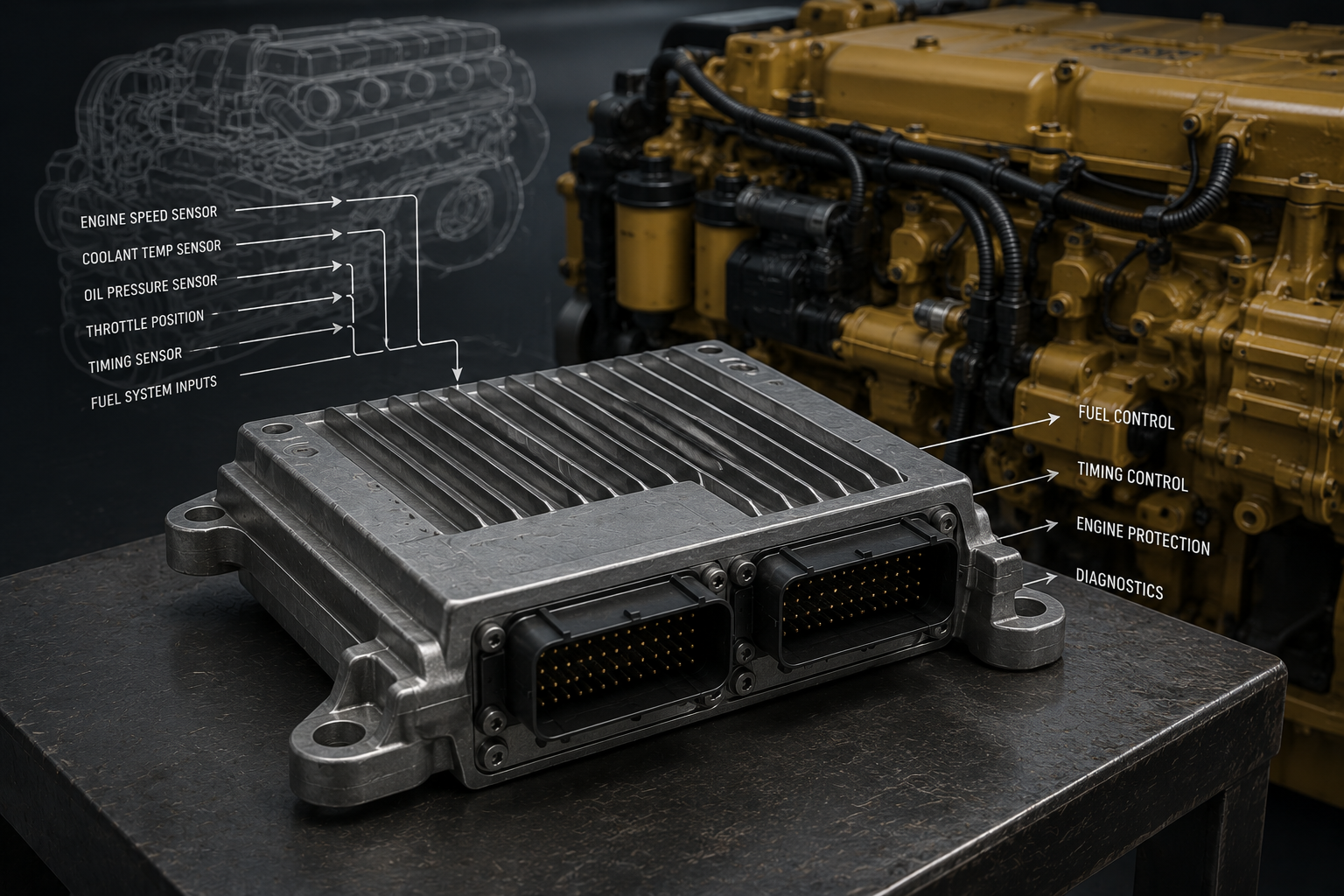
The Caterpillar 3412 ECM (Electronic Control Module) is often described as the brain of the engine.
Its job is to monitor sensors, process information, and make decisions that help the engine operate safely and efficiently.
The ECM constantly receives information from components such as:
- Engine speed sensors
- Coolant temperature sensors
- Oil pressure sensors
- Throttle position
- Timing sensors
- Fuel system inputs
Using this information, the ECM controls engine timing, monitors operating conditions, stores diagnostic codes, and protects the engine if something goes wrong.
Without the ECM, modern electronically controlled 3412 engines simply cannot operate correctly.
Does the ECM control fuel injection?
Yes.
One of the ECM's most important jobs is controlling fuel delivery.
It continuously calculates:
- When fuel should be injected
- How much fuel should be delivered
- Engine speed
- Engine load
- Protection strategies during abnormal conditions
Because it is constantly making adjustments, the engine can deliver better fuel economy, improved performance, and lower emissions compared to older mechanical systems.
Does an ECM fail very often?
Surprisingly…
No.
According to Caterpillar troubleshooting procedures, actual ECM failures are relatively uncommon.
Most reported ECM faults turn out to be problems elsewhere in the system.
Common causes include:
- Loose electrical connectors
- Corroded terminals
- Low battery voltage
- Damaged wiring
- Failed sensors
- Poor ground connections
This is why Caterpillar troubleshooting procedures always recommend checking the power supply, grounds, connectors, and sensor circuits before replacing the ECM.
Replacing the ECM without proper testing can become an expensive mistake.
Can low battery voltage cause ECM problems?
Absolutely.
This is one of the most overlooked causes of electronic engine problems.
The Caterpillar 3412 ECM depends on a stable electrical supply.
If battery voltage drops too low, the ECM may:
- Fail to communicate
- Set fault codes
- Shut down unexpectedly
- Prevent the engine from starting
- Produce intermittent electrical faults
Sometimes replacing the batteries or repairing a poor cable connection solves what initially appeared to be an ECM problem.
Why does the ECM store diagnostic codes?
Think of diagnostic codes as the engine's way of asking for help.
Whenever the ECM detects an abnormal operating condition, it stores a fault code in its memory.
These codes help technicians identify the affected circuit or system.
However, a fault code doesn't automatically mean the ECM itself has failed.
For example, if a coolant temperature sensor stops sending a signal, the ECM records the fault because it noticed missing or incorrect information.
In that situation, the sensor or wiring may be the real problem—not the ECM.
Can damaged wiring make the ECM look faulty?
Yes.
Marine engine rooms are tough environments.
Over time, wiring can suffer from:
- Heat
- Engine vibration
- Salt air
- Moisture
- Oil contamination
- Corrosion
A damaged wire may interrupt communication between the ECM and an engine sensor.
The result can be:
- Intermittent alarms
- Poor engine performance
- Loss of power
- Engine shutdown
- False fault codes
This is why technicians inspect wiring harnesses before replacing expensive electronic components.
Why are electrical connectors so important?
Many electronic problems begin with something surprisingly simple.
A loose connector.
The Caterpillar troubleshooting procedure places significant emphasis on inspecting connectors for:
- Corrosion
- Bent pins
- Loose terminals
- Moisture
- Damaged locking clips
Even a small amount of corrosion can increase electrical resistance and interfere with communication between the ECM and engine sensors.
Sometimes cleaning and securing a connector restores normal engine operation.
Can a faulty sensor cause ECM fault codes?
Definitely.
The ECM relies completely on accurate information.
If a sensor sends incorrect data—or no data at all—the ECM responds based on what it receives.
For example:
If the coolant temperature sensor reports an unrealistic value, the ECM may activate protective strategies or store diagnostic codes.
Likewise, problems with engine speed sensors or throttle position sensors can affect performance even though the ECM itself is functioning normally.
The key is identifying the root cause instead of replacing parts unnecessarily.
Should the ECM be replaced immediately?
Not usually.
Professional Caterpillar troubleshooting follows a logical process.
Before replacing the Caterpillar 3412 ECM, technicians typically verify:
- Battery voltage
- Ground circuits
- Power supply
- Wiring continuity
- Sensor operation
- Connector condition
- Active and logged diagnostic codes
Only after these checks indicate an internal ECM problem should replacement be considered.
This method often saves both time and money.
What are the warning signs of a Caterpillar 3412 ECM problem?
Some of the most common symptoms include:
- Engine won't start
- Sudden engine shutdown
- Loss of engine power
- Active warning lights
- Diagnostic fault codes
- Poor throttle response
- Intermittent engine operation
- Communication errors with service tools
Keep in mind that these symptoms don't automatically mean the ECM has failed.
They simply indicate that the engine's electronic control system requires diagnosis.
How can you help prevent ECM problems?
The good news is that many electronic issues are preventable.
Good maintenance includes:
- Keep batteries fully charged.
- Inspect battery cables regularly.
- Clean electrical connectors.
- Protect wiring from vibration and abrasion.
- Repair damaged harnesses immediately.
- Keep moisture away from electrical components.
- Investigate fault codes instead of simply clearing them.
- Perform regular electrical inspections during scheduled maintenance.
These simple habits can significantly improve the reliability of the Caterpillar 3412 ECM and the entire engine management system.
Final Thoughts
The Caterpillar 3412 ECM is one of the most important components on an electronically controlled 3412 marine engine. It continuously monitors sensors, manages fuel delivery, stores diagnostic information, and helps protect the engine from damage.
The encouraging news is that the ECM itself is often not the source of the problem. Many apparent ECM failures are actually caused by low battery voltage, poor ground connections, damaged wiring, corroded connectors, or faulty sensors.
By following a structured troubleshooting process and fixing the root cause instead of replacing parts unnecessarily, you can reduce downtime, avoid costly repairs, and keep your Caterpillar 3412 engine operating reliably for thousands of service hours.