
Why Does My Caterpillar 3512 / 3512E Marine Crank but Not Start?
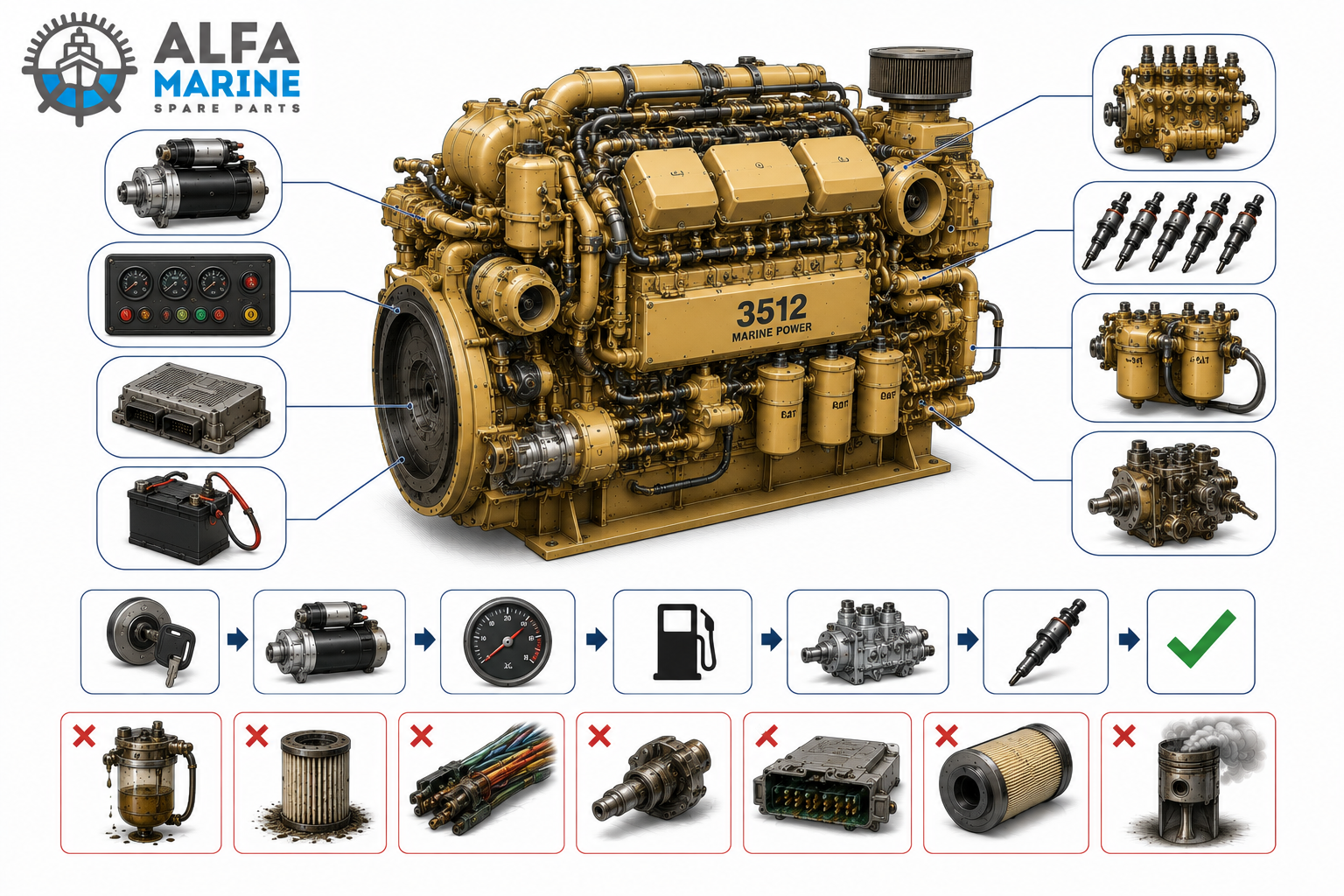
A Caterpillar 3512 or 3512E marine engine that cranks but refuses to start requires a systematic diagnosis.
A crank-no-start condition tells us that the starting system can rotate the engine, but one or more conditions necessary for combustion are missing.
Depending on the exact Caterpillar 3512 generation and engine arrangement, the problem may involve:
- Insufficient cranking speed
- Restricted fuel supply
- Air entering the fuel system
- Fuel-transfer pump problems
- Fuel injector problems
- Fuel-control problems
- Electrical power or ground problems
- Engine speed/timing information
- ECM/control problems on electronically controlled engines
- Shutdown or vessel interlock conditions
- Insufficient compression
The important question is therefore not:
“Which part should I replace?”
It is:
“At what point in the starting sequence does the engine fail?”
Caterpillar 3512 and 3512E Are Not the Same Engine Generation
Correct engine identification is essential.
The Caterpillar 3512 family covers different generations and configurations. An earlier 3512 should not automatically be diagnosed using exactly the same procedures as a later electronically controlled 3512E.
This distinction also matters when ordering injectors, fuel pumps, sensors and electronic components.
Browse:
Caterpillar 3512 Marine Engine Parts
Caterpillar 3512E Marine Engine Parts
Before ordering parts, provide:
Engine model + Engine Serial Number (ESN) + arrangement number + existing Caterpillar part number
Start With the Complete Starting Sequence
A Caterpillar 3512 can crank normally and still fail to start.
The basic diagnostic sequence is:
Cranking → fuel supply → fuel transfer → fuel injection/control → compression → combustion
On electronically controlled versions, also consider:
Electrical supply → ECM/control → engine speed/timing information → injection
The objective is to determine where that sequence stops.
Check Cranking Performance First
A large V12 diesel requires adequate cranking speed to establish the conditions needed for combustion.
The engine may appear to crank normally while actually rotating too slowly.
Check:
- Battery condition
- Battery voltage
- Starting-system condition
- Cable condition
- Ground connections
- Connection resistance
- Voltage drop during cranking
- Actual cranking performance
Low cranking speed can reduce compression temperature and make starting difficult.
Do not assume:
Engine rotates = starting system is healthy.
Did the Caterpillar 3512 Stop Suddenly?
How the failure developed can help narrow the diagnosis.
Engine Ran Normally and Suddenly Will Not Start
Investigate:
- Fuel supply
- Fuel shutoff/control
- Electrical power
- Emergency-stop condition
- Vessel interlocks
- Wiring
- Electronic control inputs where applicable
- Recent maintenance
Engine Became Progressively Harder to Start
Investigate:
- Fuel restriction
- Air entering the fuel system
- Fuel-transfer performance
- Injector condition
- Cranking performance
- Compression
- Mechanical wear
Engine Will Not Start After Fuel-System Work
Start with:
- Fuel-system priming
- Air in the fuel system
- Fuel-line connections
- Filter installation
- Components disturbed during maintenance
- Electrical connectors where applicable
The history of the problem is often one of the most useful diagnostic clues.
Check Fuel Supply Before Replacing Injectors
Before assuming an injector problem, establish that clean fuel is reaching the engine correctly.
Check:
- Fuel level
- Fuel shutoff valves
- Supply valves
- Fuel filters
- Water separators
- Fuel lines
- Tank pickup
- Fuel restriction
- Air leaks
- Fuel-transfer system
- Fuel priming
A blocked filter, closed valve or air leak can prevent starting even when the injectors themselves are serviceable.
Air in the Caterpillar 3512 Fuel System
Air intrusion deserves particular attention after:
- Fuel-filter replacement
- Fuel-line repair
- Fuel-system service
- Fuel-transfer pump work
- Running a tank very low
- Extended vessel storage
If the engine repeatedly loses prime, determine where air is entering.
Repeated manual priming is not a permanent repair.
Caterpillar 3512 Fuel Transfer Pump
One verified fuel-supply component relevant to the Caterpillar 3512 family is:
313-7770 / 3137770 — Caterpillar Fuel Transfer Pump
Caterpillar lists 3512, 3512B, 3512C and 3512E marine-engine applications among the compatible models for 313-7770.
The corresponding Cat Reman alternative listed by Caterpillar is:
10R-9838 / 10R9838 — Caterpillar Reman Fuel Transfer Pump
These numbers are useful when diagnosing a fuel-supply problem, but they should not automatically be ordered simply because the engine is called a 3512.
Confirm:
ESN + arrangement number + existing pump number
before ordering.
Can a Fuel Transfer Pump Cause a Crank-No-Start?
Yes.
The fuel-transfer pump moves fuel from the supply side toward the engine's fuel system.
If adequate fuel supply cannot be maintained, symptoms may include:
- Extended cranking
- Crank-no-start
- Engine starts and then stops
- Loss of fuel prime
- Low fuel-supply pressure
- Repeated air intrusion
If testing points toward the transfer pump, 313-7770 / 3137770 and Reman 10R-9838 / 10R9838 are verified Caterpillar 3500-family references that include 3512 marine applications.
Exact compatibility still needs to be confirmed by engine arrangement.
Can Caterpillar 3512 Injectors Cause a No-Start?
Yes.
Injector problems can contribute to:
- Difficult starting
- Extended cranking
- Rough running
- Misfire
- White or grey smoke
- Uneven cylinder operation
- Reduced power
However, a complete V12 engine suddenly refusing to start does not automatically mean twelve injectors have failed.
First investigate common systems affecting the entire engine:
Fuel supply → fuel transfer → control → electrical supply → shutdown conditions
A common-system problem can be much more plausible than simultaneous failure of every injector.
Verified Caterpillar 3512 Marine Injector Part Numbers
Caterpillar's own Parts Store confirms several injector numbers for 3512 marine applications.
They should not be treated as interchangeable.
| Caterpillar Part NumberNo-Hyphen SearchDescriptionCaterpillar Application | |||
| 4P-9077 | 4P9077 | Fuel Injector Group | 3512 Marine Engine |
| 0R-2925 | 0R2925 | Reman Fuel Injector | Alternative shown with 4P-9077 |
| 392-0204 | 3920204 | Fuel Injector Group | 3512 Marine Engine |
| 20R-1268 | 20R1268 | Reman Fuel Injector | Alternative shown with 392-0204 |
| 392-0214 | 3920214 | Fuel Injector Group | 3512 / 3512B Marine Engine |
| 20R-1275 | 20R1275 | Reman Fuel Injector | Alternative shown with 392-0214 |
| 386-1766 | 3861766 | Fuel Injector Group | 3512 / 3512B Marine Engine |
These are verified examples of Caterpillar 3512-family injectors, not a statement that every number fits every 3512.
For example:
392-0204 / 3920204
and
392-0214 / 3920214
are both associated with 3512 marine applications, but that does not make them interchangeable.
Engine arrangement matters.
392-0204 / 3920204 Caterpillar 3512 Injector
Caterpillar identifies 392-0204 / 3920204 as a fuel injector group and lists the 3512 Marine Engine among its compatible applications.
Caterpillar also displays:
20R-1268 / 20R1268
as its Reman alternative.
Therefore:
392-0204 / 3920204 → 20R-1268 / 20R1268 Reman
is the correct relationship to use when discussing this injector.
Do not confuse it with 20R-1275.
392-0214 / 3920214 Caterpillar 3512 Injector
Another verified 3512-family injector is:
392-0214 / 3920214
Caterpillar lists this injector for marine applications including:
- 3512
- 3512B
Caterpillar displays two Reman alternatives for this injector:
20R-1275 / 20R1275
and
11R-0285 / 11R0285
For the purposes of this article, the most relevant commonly referenced relationship is:
392-0214 / 3920214 → 20R-1275 / 20R1275 Reman
Again, verify the individual engine before ordering.
386-1766 / 3861766 Caterpillar 3512 Injector
Caterpillar also lists:
386-1766 / 3861766 — Fuel Injector Group
for marine-engine applications including:
- 3512
- 3512B
Caterpillar's Parts Store associates this injector with:
20R-1275 / 20R1275 — Reman Fuel Injector
This provides another example of why the existing injector number is important.
Two engines carrying the 3512 designation can require different injector references.
4P-9077 / 4P9077 Caterpillar 3512 Injector
For earlier Caterpillar 3512 applications, another verified injector is:
4P-9077 / 4P9077 — Fuel Injector Group
Caterpillar lists the 3512 Marine Engine among the compatible models.
The corresponding Reman alternative displayed by Caterpillar is:
0R-2925 / 0R2925 — Reman Fuel Injector
Therefore:
4P-9077 / 4P9077 → 0R-2925 / 0R2925 Reman
is a useful reference for applicable earlier configurations.
It should not be assumed to fit later 3512 configurations.
Why So Many Different 3512 Injector Numbers?
Because “Caterpillar 3512” describes an engine family, not one universal configuration.
Injector requirements can vary according to:
- Engine generation
- Engine Serial Number
- Arrangement number
- Rating
- Application
- Fuel-system configuration
- Production changes
- Previous updates or conversions
This is why an engineer requesting:
“12 injectors for CAT 3512”
should ideally also provide:
ESN + arrangement + existing injector part number
before the injectors are selected.
Watch the Exhaust While Cranking
Exhaust behavior during cranking can provide useful diagnostic direction.
Little or No Smoke
Investigate whether fuel is actually reaching and being injected into the cylinders.
Check:
- Fuel supply
- Fuel-transfer operation
- Fuel control
- Injection operation
- Electronic control where applicable
White or Pale Smoke
Fuel may be reaching the cylinders but failing to burn correctly.
Investigate:
- Cranking speed
- Compression
- Fuel quality
- Injection condition
- Engine temperature
- Applicable timing/control conditions
Smoke provides diagnostic information, but it does not prove a specific component has failed.
Caterpillar 3512E Requires Additional Electronic Diagnosis
The 3512E requires additional attention to its electronic engine-management system.
When a 3512E cranks but will not start, investigate:
- ECM power supply
- Grounds
- Battery voltage during cranking
- Wiring harnesses
- Connectors
- Engine speed/timing information
- Electronic fuel control
- Diagnostic codes
- Shutdown conditions
- Vessel control/interlock signals
A mechanically healthy engine still cannot start if the electronic system does not permit correct injection.
Do Not Replace a 3512E ECM Without Testing
An apparent ECM-related problem does not prove that the ECM itself has failed.
Before replacing an electronic control module, verify:
- Supply voltage
- Ground integrity
- Fuses
- Relays
- Harness condition
- Connector condition
- Voltage during cranking
- Relevant sensor/control inputs
A poor power supply or ground can make a functional ECM appear defective.
For this reason, this article does not assign a universal ECM part number to every 3512E.
ECM selection should be based on:
3512E ESN + arrangement + existing ECM part number
Engine Speed and Timing Information Matters
An electronically controlled engine needs valid information about engine rotation and position.
If the control system does not receive the required information during cranking, fuel injection can be affected.
If diagnostic data shows abnormal or missing engine-speed information, investigate:
- Applicable speed/timing sensors
- Wiring
- Connectors
- Harness condition
- Signal integrity
Sensor part numbers can vary by configuration, so they should not be selected solely from the engine family name.
Check Diagnostic Codes Before Disconnecting Components
On electronically controlled 3512 configurations, record diagnostic information before clearing codes or disconnecting components.
Record where available:
- Active diagnostic codes
- Logged codes
- Engine speed during cranking
- Supply voltage
- Shutdown status
- Fuel-system information
- Relevant starting parameters
The objective is to determine:
What does the engine-control system see while the engine is cranking?
Do not erase potentially useful evidence before recording it.
Could a Vessel Interlock Prevent Starting?
Yes.
Marine installations can include external control and protection systems.
Depending on the vessel, investigate:
- Emergency stop
- Remote start/stop
- Vessel control system
- Gear/interlock logic
- Safety shutdown circuits
- Local/remote selection
- External wiring
A crank-no-start condition is not always caused by a component physically mounted inside the engine.
This is especially important when the problem starts after:
- Electrical work
- Vessel refit
- Control-panel work
- Harness repair
- Engine-room maintenance
Can Low Compression Prevent a 3512 From Starting?
Yes.
Diesel combustion requires sufficient compression temperature.
If compression is inadequate, injected fuel may not ignite properly.
Possible mechanical causes include:
- Piston-ring wear
- Cylinder-liner wear
- Valve leakage
- Valve problems
- Cylinder-head problems
- Incorrect valve condition or adjustment
- Internal mechanical damage
However, if a previously healthy V12 suddenly develops a complete no-start condition, common fuel, electrical and control systems should generally be investigated before assuming widespread compression loss.
What if the 3512 Produces White Smoke While Cranking?
White or pale diesel-smelling exhaust can indicate that fuel is reaching at least some cylinders but combustion is not being established correctly.
Think through:
Cranking speed → injection → compression → combustion
This symptom is diagnostically different from an engine that cranks with little or no indication that fuel is reaching the cylinders.
What if the Engine Starts After Priming but Stops?
This pattern directs attention toward maintaining fuel supply.
Investigate:
- Fuel-transfer pump
- Air entering the fuel system
- Fuel restriction
- Filters
- Supply lines
- Tank pickup
- Fuel valves
The verified fuel-transfer references discussed earlier are:
313-7770 / 3137770 — Fuel Transfer Pump
10R-9838 / 10R9838 — Reman Fuel Transfer Pump
But the pump should be tested and its application verified before replacement.
What if the Problem Started After Injector Replacement?
If the engine ran before injector service and now refuses to start, begin with what changed.
Verify:
- Injector part numbers
- Correct injector application
- Installation
- Fuel-system priming
- Electrical connections where applicable
- Harness connections
- Components disturbed during repair
For example, do not replace an existing:
392-0204 / 3920204
with:
392-0214 / 3920214
simply because both numbers appear in Caterpillar 3512 marine applications.
The engine arrangement must determine the correct injector.
Caterpillar 3512 Crank-No-Start Parts Reference
The following parts are useful examples when diagnosing relevant 3512-family fuel-system problems:
| ComponentNew Part NumberReman / Alternative | ||
| Fuel Injector | 4P-9077 / 4P9077 | 0R-2925 / 0R2925 |
| Fuel Injector | 392-0204 / 3920204 | 20R-1268 / 20R1268 |
| Fuel Injector | 392-0214 / 3920214 | 20R-1275 / 20R1275 |
| Fuel Injector | 386-1766 / 3861766 | 20R-1275 / 20R1275 |
| Fuel Transfer Pump | 313-7770 / 3137770 | 10R-9838 / 10R9838 |
Important: This is not a universal shopping list for every 3512.
Each component must be verified against the individual engine.
Practical Caterpillar 3512 / 3512E Crank-No-Start Check
A logical diagnostic sequence is:
- Confirm the complete engine model.
- Record the Engine Serial Number.
- Record the arrangement number.
- Record existing injector and pump numbers.
- Review what happened before the failure.
- Check emergency-stop and vessel controls.
- Verify cranking performance.
- Verify fuel level and quality.
- Confirm fuel valves are correctly positioned.
- Inspect fuel filters and water separators.
- Check for fuel restriction.
- Check for air entering the fuel system.
- Verify correct fuel priming.
- Evaluate fuel-transfer operation.
- Observe exhaust behavior while cranking.
- On electronic engines, verify ECM power and grounds.
- Record diagnostic codes.
- Check engine-speed/timing information where applicable.
- Inspect wiring and connectors.
- Evaluate injector operation when evidence points toward injection.
- Investigate compression when operating history supports it.
- Identify the actual failed component before ordering parts.
The objective is:
Cranking → fuel supply → fuel transfer → fuel control → injection → compression → combustion
Caterpillar 3512 Marine Engine Parts
For Caterpillar 3512 marine applications, browse:
Caterpillar 3512 Marine Engine Parts
Parts enquiries can include:
- Fuel injectors
- Fuel-transfer pumps
- Fuel-system components
- Turbochargers
- Cylinder heads
- Pistons
- Piston rings
- Cylinder liners
- Bearings
- Water pumps
- Oil pumps
- Cooling-system components
- Gaskets and seals
- Overhaul components
Examples of verified 3512-family fuel-system numbers discussed in this article include:
4P-9077 / 4P9077
0R-2925 / 0R2925
392-0204 / 3920204
20R-1268 / 20R1268
392-0214 / 3920214
20R-1275 / 20R1275
386-1766 / 3861766
313-7770 / 3137770
10R-9838 / 10R9838
Exact compatibility must be verified before ordering.
Caterpillar 3512E Marine Engine Parts
For 3512E applications, browse:
Caterpillar 3512E Marine Engine Parts
Parts enquiries can include:
- Fuel-system components
- Fuel-transfer pumps
- Electronic injection components
- Turbochargers
- ECM/control components
- Engine sensors
- Wiring components
- Cylinder heads
- Pistons
- Cylinder liners
- Bearings
- Cooling-system components
- Gaskets and seals
- Overhaul components
The verified 313-7770 / 3137770 fuel transfer pump and 10R-9838 / 10R9838 Reman fuel transfer pump are listed by Caterpillar for 3512E marine-engine applications, but ESN and arrangement verification remains necessary.
Request Caterpillar 3512 / 3512E Parts
If your Caterpillar 3512 or 3512E marine engine cranks but will not start, avoid immediately ordering twelve injectors, a fuel pump or an ECM.
First determine where the starting sequence fails:
Cranking → fuel supply → fuel transfer → injection/control → compression → combustion
For accurate identification, provide:
Engine model + Engine Serial Number + arrangement number + existing Caterpillar part number + clear photographs
Email: request@alfamarinespareparts.com
Request a Quote
Alfa Marine Spare Parts
Frequently Asked Questions
Why does my Caterpillar 3512 crank but not start?
Start with cranking performance and fuel supply. Check fuel level, valves, filters, air intrusion, priming and fuel-transfer operation before assuming that the injectors have failed.
Can the 3512 fuel-transfer pump prevent starting?
Yes. A fuel-transfer problem can prevent adequate fuel supply. 313-7770 / 3137770 and Reman 10R-9838 / 10R9838 are verified Caterpillar references covering 3512-family marine applications, subject to exact engine verification.
What injector fits a Caterpillar 3512 marine engine?
There is no single universal injector. Verified Caterpillar examples include 4P-9077 / 4P9077, 392-0204 / 3920204, 392-0214 / 3920214 and 386-1766 / 3861766. The correct injector depends on the engine configuration.
What is the Reman injector for 392-0204?
Caterpillar lists 20R-1268 / 20R1268 as the Reman alternative associated with 392-0204 / 3920204.
What is the Reman injector for 392-0214?
Caterpillar lists 20R-1275 / 20R1275 as a Reman alternative associated with 392-0214 / 3920214.
What is the Reman injector for 4P-9077?
Caterpillar lists 0R-2925 / 0R2925 as the Reman alternative associated with 4P-9077 / 4P9077.
Why does my 3512 produce white smoke while cranking?
Fuel may be reaching the cylinders but failing to burn correctly. Check cranking performance, injection, compression and the applicable control conditions.
Can an ECM problem prevent a 3512E from starting?
Potentially. However, ECM power, grounds, wiring, connectors and relevant control inputs should be tested before replacing the ECM.
Can low compression prevent a Caterpillar 3512 from starting?
Yes. Insufficient compression can prevent adequate combustion temperature from developing, particularly during cold starting.
What information should I provide when ordering Caterpillar 3512 parts?
Provide the complete engine model, Engine Serial Number, arrangement number, existing Caterpillar part number and clear photographs.